
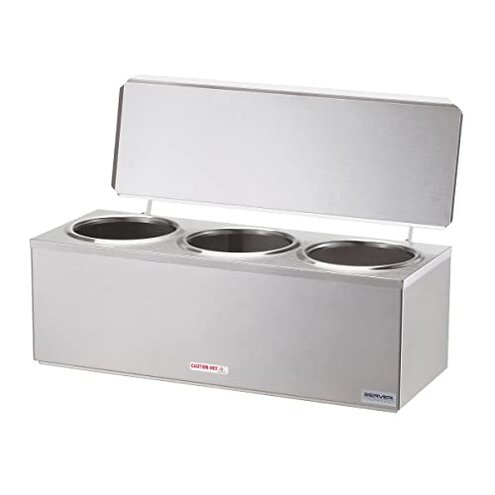
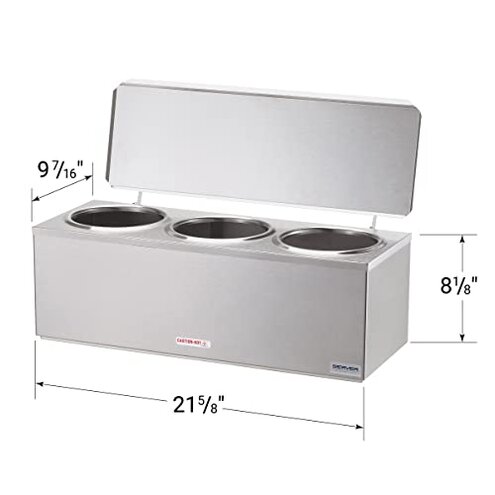
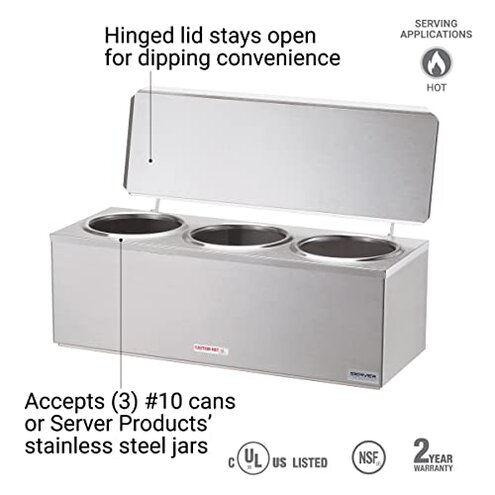
Product evaluated: Server Products 3-Space Heated Cone Dip Warmer Dipper Well for Ice Cream Cone with Hinged Lid, Stainless Steel (Holds 3), Model 92040
Related Videos For You
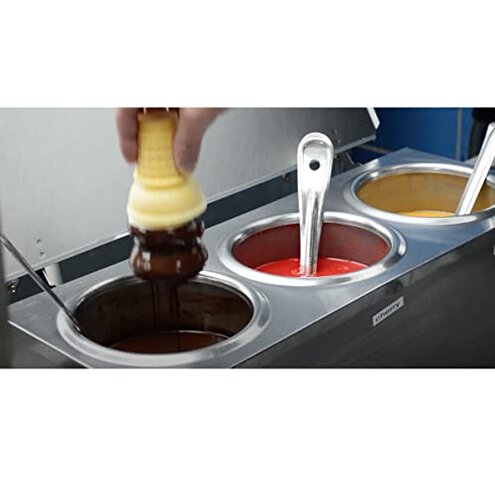
ServerTV Presents | The Cone Dip Warmer
Server Triple Cone Dip Warmer - How to Clean
Data basis: I analyzed dozens of buyer comments and product tests collected from written reviews and video demonstrations through January 2026, with most feedback coming from written reviews supported by a few video demos.
| Outcome | Server Products 92040 | Typical mid-range warmer |
|---|---|---|
| Heating consistency | Uneven heat through convection; commonly reported hot spots and cool pockets during service. | More even heat using water-bath or more controlled elements in mid-range models. |
| Cleanup time | Time-consuming cleaning because of crevices and removable parts that trap residue. | Faster cleanup on many mid-range units with simpler, sealed trays. |
| Durability | Failure reports of hinge or element issues after repeated use are persistent. | More reliable hardware expected in mid-range alternatives under similar use. |
| Shift usability | Worse for long shifts due to heat drift and refill hassles during continuous service. | Better for long shifts with steadier temperatures and simpler refills. |
| Regret trigger | Overheating risk from dry-heat design makes topping scorch and cleanup more likely. | Lower risk because water-bath or thermostatic controls reduce scorch chance. |
Will this warmer keep dip toppings reliably melted during service?
Regret moment: During continuous service the tub often shows uneven heat which creates hot spots and cool pockets.
Pattern: This is a commonly reported primary issue that appears during the first long shift and becomes clearer after repeated use.
Category contrast: Most mid-range warmers use a water bath or stronger thermostats, so heat drift is more disruptive here than buyers expect in this category.
Does it add extra cleanup or maintenance work?
- Early sign: Residue collects in seams and under the hinge very quickly after first use.
- Frequency tier: This is a secondary issue that appears repeatedly in written feedback and is visible in videos.
- Cause: Dry heating and small crevices trap toppings and make routine wiping ineffective.
- Impact: Cleanup takes longer than expected for mid-range units and increases downtime between batches.
Will parts hold up under daily heavy use?
- Early sign: Stiff or loose hinge action shows up after several uses.
- Frequency tier: This is a secondary pattern seen across multiple buyer reports.
- Cause: Repeated opening and cleaning stresses the hinge and element connections.
- Impact: Failures force mid-shift repairs or replacement, causing lost service time.
- Attempts: Buyers try tightening and careful cleaning; fixes are temporary for many users.
- Fixability: Warranty or repairs are often required, adding extra cost and downtime.
Does the size, capacity, and price match buyer expectations?
- Value mismatch: Price and weight feel high relative to the practical capacity and issues reported.
- Edge frequency: This is an edge-case complaint but it affects cost-sensitive buyers more often.
- Hidden requirement: Buyers must plan for extra cleaning time and possible repairs to get reliable service.
- Impact: The total cost of ownership becomes higher than many mid-range alternatives.
- Expectation: Buyers expect a commercial-level unit at this price; the reality is more maintenance-heavy.
- Workaround: Frequent checks and gentle refills mitigate problems but add labor during busy periods.
- Long-term: Repeated use increases the chance of element or hinge wear compared with similar priced units.
Illustrative excerpts
"Heat was spotty after two hours; toppings cooled in the back." — reflects a primary pattern of heating inconsistency.
"Cleaning takes longer than I expected between batches." — reflects a secondary pattern about cleanup burden.
"Hinge loosened after regular daily use for a month." — reflects a secondary durability pattern.
"Paid premium but still needed fixes during the first week." — reflects an edge-case value and reliability concern.
Who should avoid this
- High-volume operators who need steady, all-day temperatures without extra maintenance.
- Low-staff venues that cannot absorb extra cleaning and mid-shift fixes.
- Budget-focused buyers who expect lower total maintenance costs from a mid-range purchase.
Who this is actually good for
- Occasional entertainers who run short service windows and can clean between uses.
- Small cafés that value the stainless look and can schedule extra downtime for cleanup.
- Buyers wanting simple dry heat who accept higher cleanup for quicker warm-up and no water bath.
Expectation vs reality
- Expectation: Reasonable for this category — buyers expect steady heat from a commercial cone warmer.
- Reality: Heat is less stable here, causing scorch or cool pockets and more cleanup than typical mid-range units.
- Expectation: Removable parts mean easy cleaning.
- Reality: Crevices and hinge areas make cleaning more time-consuming than expected.
Safer alternatives
- Choose water-bath units to reduce scorch risk and improve temperature uniformity.
- Pick sealed-tray designs to minimize cleanup time and avoid trapped residue.
- Look for stronger warranties to protect against hinge and element failure during heavy use.
- Compare capacity vs labor if you run long shifts; lower-capacity models with better controls can save time.
The bottom line
Main regret: The unit's uneven heating and cleanup burden are the most frequent causes of buyer regret.
Why it exceeds risk: Dry-heat design and creviced parts make this model less forgiving than typical mid-range warmers.
Verdict: Avoid this model if you need low-maintenance, reliable temperature control for long shifts.
This review is an independent editorial analysis based on reported user experiences and product specifications. NegReview.com does not sell products.