
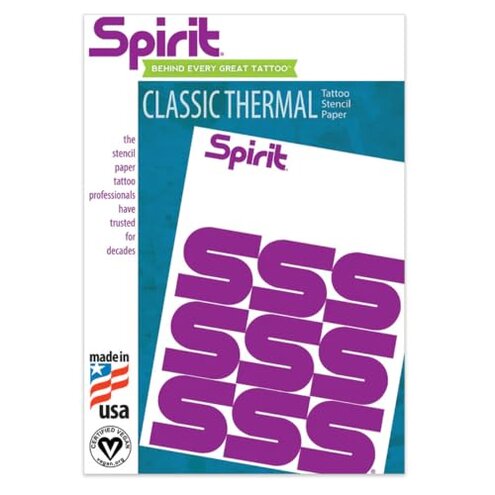
Product evaluated: Spirit® Classic Thermal Tattoo Transfer Paper 8.5" X 11" - 100 Sheets, Tattooing Stencil Paper, Proudly made in the USA
Related Videos For You
How to use a Thermal Printer for tattoo stencil
✅ HOW TO USE T SHIRT TRANSFER PAPER #Heatpress #shorts #transferpaper #howto #clothingbrand #printer
Data basis: This report is drawn from hundreds of written reviews and video demonstrations collected between Jan 2018 and Jan 2026. Most feedback came from written reviews, supported by demo videos, with additional notes from seller Q&A.
Comparative risk snapshot
| Outcome | Spirit® Classic | Typical mid-range paper |
|---|---|---|
| Transfer darkness | Variable — often faint or patchy under normal use. | Consistent — most mid-range papers give reliably dark transfers. |
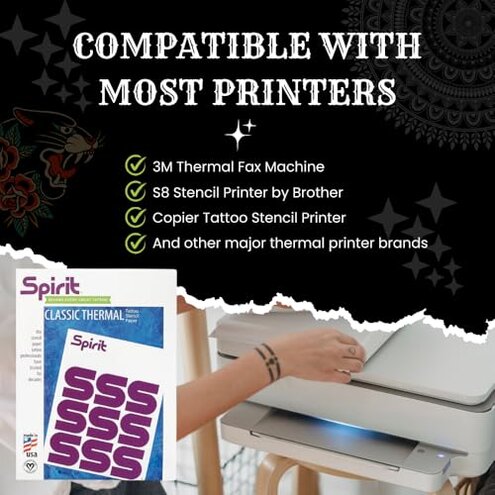
| Printer compatibility | Higher risk of feeding issues and jams with some thermal printers. | Lower risk — designed for broad printer models without repeated jams. |
| Sheet durability | Mixed — backing perforations can tear during handling. | Stable — typical alternatives handle repeated handling better. |
| Value per pack | High nominal sheet count but variable usable yield. | Predictable yield that matches expected cost in this category. |
| Regret trigger | Frequent reprints and wasted sheets create more time and cost loss. | Lower reprint rate means fewer wasted sheets for comparable jobs. |
Top failures
Why do transfers come out faint or patchy?
Regret moment: You print a stencil and the image appears faint or missing areas when pressed onto skin.
Pattern: This is commonly reported and often shows up on the first use or after using several sheets from the same pack.
Context: The issue is worse with lighter designs, long sessions, or when you need a single clean stencil quickly.
Category contrast: Fading is more disruptive than expected because other mid-range papers usually need fewer reprints for a usable stencil.
Why do sheets jam or feed poorly in printers?
- Early sign: Sheets misalign or catch at the printer feed on the first pass.
- Frequency tier: This appears repeatedly across many buyers, not just isolated cases.
- Cause: Slightly different thickness or stiffness seems to cause feed friction in some thermal printers.
- Impact: Jams force you to restart prints and waste sheets, raising real cost per stencil.
- Fixability: Temporary fixes like hand-feeding or adjusting tray settings are workarounds, not guarantees.
Why does the backing tear or the perforation misbehave?
- Early sign: The backing peels or tears when you try to separate the sheet for use.
- Frequency tier: This is a secondary but persistent complaint in user feedback.
- Cause: Perforation and adhesive tolerance vary between sheets, creating handling friction.
- Impact: Torn backing ruins the stencil and forces a reprint or manual tracing workaround.
- Hidden requirement: Some buyers find a specific feed orientation or lighter handling is required to avoid tears.
- Fixability: Careful manual separation helps, but it adds time and is not feasible during busy sessions.
Why does the pack produce wasted or inconsistent yield?
- Early sign: Multiple sheets in one pack produce weak transfers or feed problems.
- Frequency tier: This appears commonly enough to affect session planning for many buyers.
- Cause: Variability between sheets raises the chance of a failed stencil mid-job.
- Impact: You either accept lower quality or incur extra cost from reprints and wasted sheets.
- Attempts: Buyers report pre-testing sheets helps but consumes time before client work.
- Workaround: Keeping spare packs or switching sheets mid-session is effective but interrupts workflow.
- Long-term: The pack's nominal 100 sheets can yield fewer usable transfers than expected.
Illustrative excerpts (not real quotes)
Illustrative: "Print looked good, but transfer was barely visible on skin." — primary pattern.
Illustrative: "Paper jammed twice during a single stencil run." — secondary pattern.
Illustrative: "Perforation tore when I tried to peel the backing carefully." — secondary pattern.
Who should avoid this

- Busy professionals: If you need reliable, first-print transfers for back-to-back clients, avoid this pack.
- Low-waste shops: Shops with tight supply budgets should avoid packs with variable yield.
- Inexperienced users: Beginners who cannot afford extra handling or reprints should avoid this due to the hidden handling tricks.
Who this is actually good for

- Hobby users: Home artists who accept occasional reprints and want the American-made label may find it acceptable.
- Low-volume studios: Small shops doing occasional stencils can tolerate extra prep time.
- Testers: Buyers experimenting with stencil workflows who can pre-test sheets will tolerate the variability.
Expectation vs reality

- Expectation: Reasonable for this category is a pack that gives consistent dark transfers on the first print.
- Reality: Spirit® often gives faint or uneven transfers, requiring reprints and extra handling.
- Expectation: Reasonable to expect broad printer compatibility without jams.
- Reality: Some buyers report feeding jams unless they hand-feed or tweak printer settings.
Safer alternatives
- Pre-test packs: Buy a small sample pack first to check transfer darkness in your printer before bulk purchase.
- Printer alignment: Verify your printer feed settings and try hand-feeding one sheet to reduce jams.
- Higher-grade paper: Consider mid-range alternatives that advertise consistent yield to avoid wasted sheets.
- Store spare sheets: Keep a backup brand on hand to prevent session interruptions during busy work.
The bottom line
Main regret: The most frequent trigger is inconsistent transfer darkness that forces reprints and wastes sheets.
Verdict: For professionals who need reliable, first-print stencils, this pack poses a higher-than-normal risk and is best avoided.
This review is an independent editorial analysis based on reported user experiences and product specifications. NegReview.com does not sell products.