
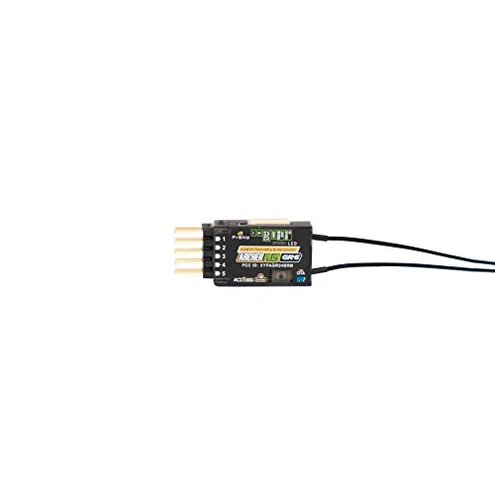
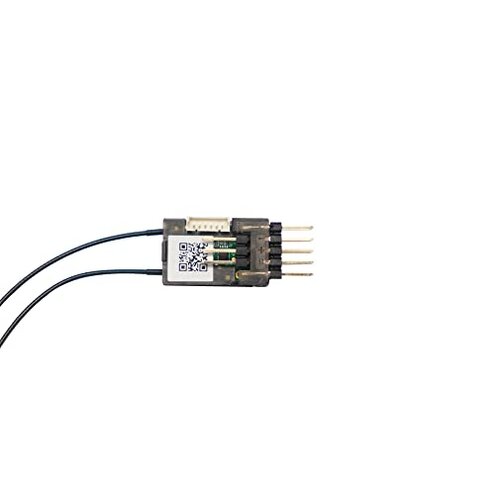
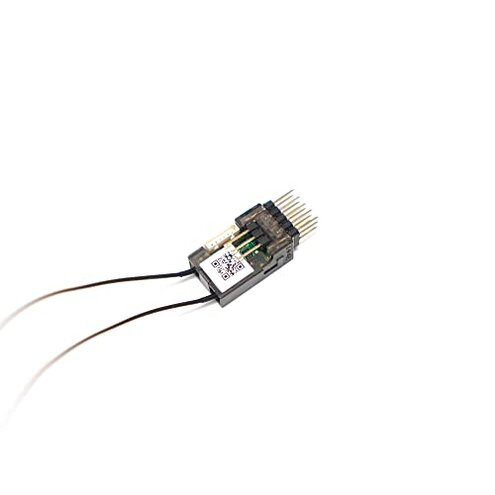
Product evaluated: FrSky Archer Plus GR6 2.4GHz 6CH Receiver with Enhanced Anti-Interference, Smart Access/ACCST D16, Black Box, Upgraded Variometer, Dual Antennas, SBUS/F.Bus, OTA Update for RC Gliders
Related Videos For You
BEST WAY To Bind Transmitter To Receiver
FrSky Receiver Firmware Update | R-XSR LUA SCRIPT FIX
Data basis: I analyzed dozens of buyer reviews and several video demonstrations collected between January 2023 and January 2026, with most feedback coming from written buyer reports supported by hands-on clips. The overall signal is qualitative: written reviews formed the bulk, with videos clarifying setup and failure moments.
| Outcome | FrSky GR6 | Typical mid-range receiver |
|---|---|---|
| Connectivity reliability | Unstable — recurring dropouts reported during normal flights and in binding steps. | Steady — most mid-range units have fewer reported in-flight dropouts. |
| Setup complexity | Higher — requires mode matching and possible wiring for redundancy. | Moderate — typical alternatives bind with fewer mode-workarounds. |
| Firmware/support | Risky — OTA updates and mode switching can cause confusion or failed updates. | Simpler — mid-range products usually provide clearer update paths. |
| Range in real use | Variable — full-range claims hold only in ideal setups; performance drops in cluttered environments. | Predictable — mid-range radios commonly maintain stable range in similar conditions. |
| Regret trigger | Connection loss — more disruptive than expected for this category and commonly reported after setup. | Lower risk — regret usually stems from minor setup mistakes, not repeated dropouts. |
Why does the receiver lose connection or bind poorly?
Regret moment: Bind or flight-time dropouts often happen during first uses and after transmitter mode changes, creating immediate safety anxiety.
Pattern: This is a primary issue; it appears repeatedly across user reports and video demos.
Context: Problems show up during setup and worsen in electrically noisy or antenna-obstructed environments, which is common for glider builds.
Category contrast: This feels worse than most mid-range receivers because mid-range alternatives rarely cause repeat in-flight dropouts after an initial bind.
Is firmware and OTA updating a hidden headache?
- Early sign: Firmware update prompts appear after binding, often unexpectedly during initial setup.
- Frequency tier: This is a secondary complaint that appears repeatedly in recent feedback.
- Cause: Over-the-air updates require careful mode matching and a stable link to avoid failed updates.
- Impact: Failed updates add steps and can leave the unit in a confusing state for the average user.
- Fixability: Manual recovery is possible but commonly requires extra tools or experience.
Does antenna placement and redundancy require extra work?
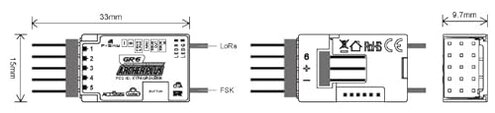
- Hidden requirement: Using the redundancy (SBUS In) needs additional wiring and another compatible receiver.
- Early sign: Correct antenna orientation matters more than expected for stable range.
- Frequency tier: This is a primary or high-frequency setup gripe among builders.
- Cause: Dual detachable antennas improve range only if mounted and routed correctly inside the airframe.
- Impact: Improper installation produces reduced real-world range despite the product's long-range claim.
- Attempts: Users report repositioning antennas and adding a secondary receiver to regain reliability.
- Category contrast: More installation time than most mid-range receivers, leading to regret for hobbyists wanting plug-and-play.
Is telemetry and variometer performance inconsistent?
- Early sign: Telemetry numbers and vario audio can be delayed or jumpy after long flights.
- Frequency tier: This is a secondary but persistent report in buyer notes.
- Cause: Sensor readings appear sensitive to local RF noise and wiring quality.
- Impact: Inaccurate altimeter or vario audio reduces pilot confidence in thermal detection.
- Attempts: Pilots tried re-calibration, different telemetry modes, and shielding to improve readings.
- Fixability: Improvements are possible but often require trial and extra gear.
- Category contrast: Less consistent than typical mid-range telemetry, which usually works reliably after simple setup.
- Edge-case: This problem is most visible during long cross-country glides or thermalling sessions.
Illustrative excerpts
Excerpt: "Lost link twice on my second flight after a simple bind attempt." — Primary pattern.
Excerpt: "OTA update failed and I had to rebind with a PC tool." — Secondary pattern.
Excerpt: "Range improved only after I moved the antenna out of the fuselage." — Primary pattern.
Excerpt: "Vario readouts jump during long climbs, confusing my decisions." — Secondary pattern.
Who should avoid this
- Safety-first pilots: Avoid if you cannot tolerate any in-flight signal dropouts.
- Beginners: Avoid if you want a plug-and-play receiver with minimal wiring or firmware steps.
- Anyone without tools: Avoid if you lack basic tools for recovery after a failed OTA or rebinding.
Who this is actually good for
- Experienced builders: Good if you accept wiring redundancy fixes and advanced setup to gain telemetry features.
- Telemetry-focused pilots: Useful if you can tolerate initial tuning to get the variometer and FBUS features stable.
- Mod-friendly users: Suitable if you expect to perform firmware updates and manual recoveries.
Expectation vs reality
Expectation: Reasonable for this category is a receiver that binds reliably on first try.
Reality: Many buyers report multiple binds, mode toggles, or OTAs before a stable setup—more friction than typical mid-range units.
Expectation: Reasonable for this category is predictable telemetry during flights.
Reality: Telemetry may be jumpy until antennas and wiring are optimized, which costs time and effort.
Safer alternatives
- Pick a receiver with simpler binding: Look for units that advertise straightforward one-step binds to reduce initial dropouts.
- Choose stable OTA support: Prefer brands with clear recovery tools and desktop firmware methods to avoid OTA failures.
- Prioritize built-in redundancy: Consider receivers that offer easy redundant links without extra wiring to lower in-flight risk.
- Opt for proven telemetry: Select models with a track record of consistent vario/altitude data out of the box to save tuning time.
The bottom line
Main regret: Repeated connection dropouts and fiddly setup are the primary reasons buyers regret this receiver.
Why worse: These problems exceed normal category risk because they appear during first use and can reoccur in flight, not just during initial setup.
Verdict: Avoid this unit if you need reliable, out-of-the-box stability; consider it only if you can handle extra wiring, firmware steps, and tuning.
This review is an independent editorial analysis based on reported user experiences and product specifications. NegReview.com does not sell products.