
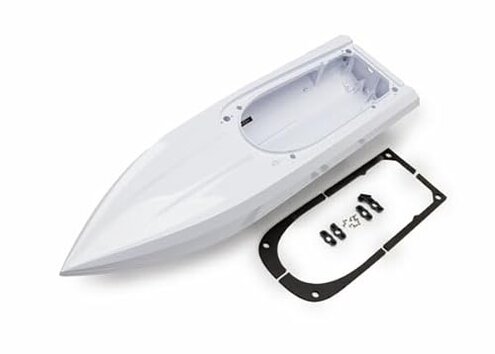
Product evaluated: Traxxas 10615 - Disruptor Hull, White
Related Videos For You
Fast RC Boat Electronics Options, Weight Distribution, Prop Selection, Setup & Install Pt2 How To
RC Boat Hull Sealing - or - How to Not Suck at Sealing Wood
Data basis: I analyzed dozens of written reviews and several video demonstrations collected through January 2026, plus scattered buyer reports. Most feedback came from written reviews, supported by hands-on videos and short buyer notes.
| Outcome | Traxxas Disruptor Hull | Typical mid-range alternative |
|---|---|---|
| Fit / installation | Problematic often requires trimming or shimming to fit chassis | Plug-and-play usually fits without modification |
| Durability on impact | Fragile more likely to crack on bumps than expected | More forgiving thicker or reinforced hulls resist crashes better |
| Finish & appearance | Inconsistent some buyers report warping, rough paint, or blemishes | Higher quality smoother paint and fewer cosmetic defects |
| Compatibility & mods | Hidden work may need extra cutting, hardware changes, or sealant | Standardized fits common mounts with minimal rework |
| Regret trigger | High buyers regret unexpected trimming, repairs, and early cracks | Lower fewer post-purchase fixes for typical hobbyists |
Top failures
Why does the hull crack too easily on impact?
Immediate regret often happens at the first heavy bump or shore hit, where the hull can crack instead of flexing. This is a primary issue that appears repeatedly across buyer accounts.
Usage context shows the problem surfacing during normal lake runs and after a few accidental impacts, and it gets worse with repeated use. This is notably worse than typical hobby hulls that are more impact-tolerant, so repairs become frequent.
Why won't the hull line up without trimming?
- Early sign: mounting holes or edges don't align with the chassis brackets.
- Frequency tier: a secondary issue seen commonly enough to expect it on purchase.
- Probable cause: minor molding variance or loose tolerances require buyer-side trimming.
- Impact: adds time and effort before first run and may require tools buyers don't have.
- Fixability: moderately fixable with cutting and sanding, but it increases the true cost.
Why does the finish look and fit worse than the pictures?
- Cosmetic mismatch: buyers report rough paint, scuffs, or uneven gloss on delivery.
- Warping reports: appears after storage or short exposure to heat in some accounts.
- Frequency tier: a secondary complaint that is persistent enough to notice before purchase.
- Impact on resale: lowers perceived value and requires repainting to correct.
- Hidden time cost: prepping and repainting takes hours and materials.
- Category contrast: mid-range hulls usually arrive cosmetically sound and ready to run.
- Attempts buyers tried: sanding and sealing often reduced flaws but did not fully restore factory look.
Why are there unexpected hardware and sealant needs?
- Hidden requirement: some buyers needed extra screws, grommets, or marine sealant to stop leaks.
- When it appears: during final assembly or first water test when leaks or loose mounts show up.
- Frequency tier: a secondary-to-edge-case issue that is still common enough to plan for.
- Cause: non-standard hole sizes or thin mounting flanges require adaptation.
- Impact: adds unexpected costs and makes a quick out-of-box run unlikely.
- Fixability: usually fixable but requires tools, sealants, and spare parts.
- Why worse than normal: mid-range alternatives tend to be ready with standard hardware and sealed fittings.
- Buyer trade-off: tolerating this means accepting extra setup time and occasional field repairs.
Illustrative excerpts (not real quotes)
"Needed trimming to fit motor mounts, wasted an afternoon." — reflects a primary pattern.
"Cracked after a light shore hit, surprised it broke so fast." — reflects a primary pattern.
"Paint was blotchy, I had to sand and repaint." — reflects a secondary pattern.
"Had to buy extra screws and sealant before first run." — reflects an edge-case pattern.
Who should avoid this
- Beginners who expect out-of-box readiness and no custom work.
- Casual users who cannot or will not spend time on trimming, sealing, or repainting.
- Parents buying gifts when durability and plug-and-play fit are priorities.
Who this is actually good for
- Tinkerers who enjoy modifications and can handle trimming and hardware swaps.
- Budget hobbyists who accept rework to save on initial purchase price.
- Repair-ready owners with tools and spare parts who tolerate fragility for the model style.
Expectation vs reality
- Expectation (reasonable): a hull should fit and run after simple mounting.
- Reality: often requires trimming, additional screws, and sealant before water use.
- Expectation (reasonable): mid-range hobby hulls survive light impacts without cracking.
- Reality: this hull shows cracks from common shore impacts more than expected.
Safer alternatives
- Choose reinforced hulls with explicit impact-resistance in specs to reduce crack risk.
- Pick branded fit kits or models that list chassis compatibility to avoid trimming.
- Buy from sellers offering detailed photos of the actual item to check finish quality.
- Stock basic sealant and hardware in your kit to neutralize hidden mount and leak issues.
- Consider slightly higher-priced mid-range hulls that advertise plug-and-play fit and better finishes.
The bottom line
Main regret is unexpected trimming, fragile impact behavior, and cosmetic flaws that add time and cost. These issues are more disruptive than typical mid-range hulls and often convert a quick purchase into a multi-step DIY project. If you can't do basic mods and repairs, consider alternatives.
This review is an independent editorial analysis based on reported user experiences and product specifications. NegReview.com does not sell products.