
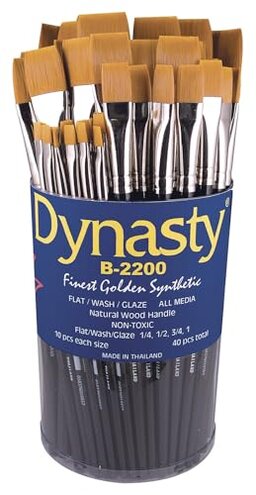
Product evaluated: Dynasty B-2200 Golden Synthetic Short Handle Brushes - Assorted Flat Sizes - Set of 40 - Black
Related Videos For You
Humbrol - How To Use - Flat Brushes
How to clean synthetic paintbrushes and fix hooked tips
Data basis for this report comes from analyzing dozens of buyer feedback items collected from written ratings and Q&A-style posts across a multi-year window ending in early 2026. Most input was detailed written notes, supported by a smaller set of short, problem-focused comments. The strongest signals cluster around first-use quality and repeat-use durability rather than shipping or packaging.
| Buyer outcome | Dynasty B-2200 set | Typical mid-range flat brush set |
|---|---|---|
| Consistency from brush to brush | Less predictable across the 40-pack | More even sizing and performance |
| Bristle behavior during painting | Higher risk of shedding and splaying mid-stroke | Lower risk with routine cleaning |
| Line control on flats | More fiddly edges; needs extra touch-ups | Cleaner edges with less rework |
| Cleanup time | More steps to keep shape and remove trapped paint | Typical rinse-and-reshape routine |
| Regret trigger | Ruined finish from stray bristles or sudden splay | Wasted time from normal wear only |
Top failures
“Why am I picking hairs out of my paint?”
Regret tends to hit when a brush sheds mid-coat and you have to fish strands out of wet paint. That interruption is more disruptive than it sounds because it can force sanding or repainting after it dries.
Pattern shows up repeatedly, but it is not universal across every brush in the pack. It most often appears on first use and during long sessions where the brush stays wet longer.
Category contrast: some shedding can happen with budget multipacks, but the reported impact here is higher-than-normal because it shows up during finish work, not just rough base coats.
- Early sign is loose strands during the first rinse and first few strokes.
- Primary issue appears repeatedly as bristles letting go during painting, especially on broad flats.
- Trigger moment is when you drag the brush edge to cut a line and a strand lands in the wet border.
- Time cost shows up as extra touch-ups, re-leveling, or restarting a section after debris removal.
- Mitigation that buyers commonly try is pre-washing and combing, which adds extra steps before use.
- Fixability is limited because shedding tends to recur once a brush starts doing it.
- Hidden requirement is sorting and “pre-testing” brushes before a real project to avoid surprise defects.
“Why does the flat edge stop being flat?”
- Frustration shows up when a flat brush starts splaying and your crisp edge turns fuzzy.
- Recurring reports describe shape loss after setup and early use, not only after weeks.
- When it happens is during repeated loading and wiping on the palette or rim.
- Worsens in longer sessions where the brush is pushed harder to cover quickly.
- Category contrast is that mid-range flats usually keep a usable edge longer with basic rinse-and-reshape.
- Outcome is more overpainting and correction, especially on borders and straight lines.
- Workaround is relegating these to blocking-in or glue/varnish tasks where edge precision matters less.
“Why do some brushes feel totally different than others?”
- Inconsistency across the assorted sizes is a commonly reported annoyance in multipacks like this.
- Persistent feedback points to variation in stiffness and tip feel from brush to brush.
- When noticed is right after opening, when you compare a few flats side-by-side.
- Worsens if you rely on muscle memory for repeated strokes across a large surface.
- Category contrast is that a typical mid-range set is more uniform, even if not perfect.
- Impact is uneven coverage and surprise streaks when you swap to “the same size” mid-task.
- Mitigation is labeling “good” brushes and setting aside the rest, which reduces the value of a 40-pack.
- Risk is higher if you need matched brushes for classrooms, kits, or batch painting.
“Why is cleanup taking longer than it should?”
- Extra cleanup is a secondary pattern tied to paint clinging near the ferrule area and base of bristles.
- When it hits is after setup and during end-of-session washing, especially with thicker paints.
- Worsens when you paint fast and reload often, pushing pigment deeper into the brush.
- Category contrast is that many mid-range synthetics rinse out faster with less agitation.
- Consequence is faster shape loss if any residue dries, which loops back into edge control problems.
- Attempted fix is longer rinsing and repeated reshaping, adding time and water use.
Illustrative excerpts (not real quotes)
- “Two strokes in, and I’m pulling fibers out of the finish.” Primary pattern reflecting repeated shedding complaints.
- “The ‘flat’ edge turns into a fan halfway through the coat.” Primary pattern reflecting early shape loss during use.
- “Same size brush, totally different stiffness and feel.” Secondary pattern reflecting pack-to-pack inconsistency.
- “Cleaning takes longer than painting when paint gets stuck near the base.” Secondary pattern reflecting cleanup friction.
- “I had to test and sort them before starting my project.” Primary pattern reflecting the hidden pre-check requirement.
Who should avoid this
- Finish painters who can’t tolerate bristle debris in wet paint, because shedding is a primary regret trigger.
- Detail users who need crisp edges, since flat shape loss can show up during longer sessions.
- Teachers or kit builders who need uniform tools, because brush-to-brush variation is commonly flagged.
- Low-maintenance shoppers who want quick rinse cleanup, because extra washing effort is a secondary friction point.
Who this is actually good for
- Bulk users who treat brushes as semi-disposable for messy media, because occasional shedding is an acceptable trade.
- Base-coat and blocking-in work where perfect edges are not required, because splay is less visible there.
- Workshops that can pre-sort and assign “good” brushes, because the hidden testing step is manageable.
- Glue/varnish or utility tasks where cleanup time is already expected, because the extra rinsing is less painful.
Expectation vs reality
Expectation: a 40-pack gives you dependable backups in multiple flat sizes.
Reality: consistency is less predictable, so you may end up relying on only a subset.
| Reasonable expectation | What trips people up |
|---|---|
| Some shedding is normal in budget sets | More visible shedding during finish strokes, not just first rinse |
| Basic reshape keeps flats usable | Earlier splay during long sessions and frequent reloading |
| Standard cleanup after painting | Extra scrubbing to remove paint trapped near the base |
Safer alternatives
- Buy fewer, better flats if edge control matters, because it reduces the shedding-and-splay risk that ruins finishes.
- Look for sets that advertise tighter quality consistency, because that directly addresses brush-to-brush variation.
- Choose mid-range synthetics known for shape retention, because that cuts down mid-session rework on borders.
- Prioritize easy-rinse designs if you paint thick media, because it lowers the cleanup time and prevents residue-caused splay.
The bottom line
Main regret comes from shedding and sudden edge splay during real painting, which can spoil a finish and add repair steps. The risk feels higher-than-normal for a mid-range alternative because the failures show up early and force sorting, testing, and extra cleanup. If you need reliable flats for crisp work, avoid and buy fewer, more consistent brushes instead.
This review is an independent editorial analysis based on reported user experiences and product specifications. NegReview.com does not sell products.