
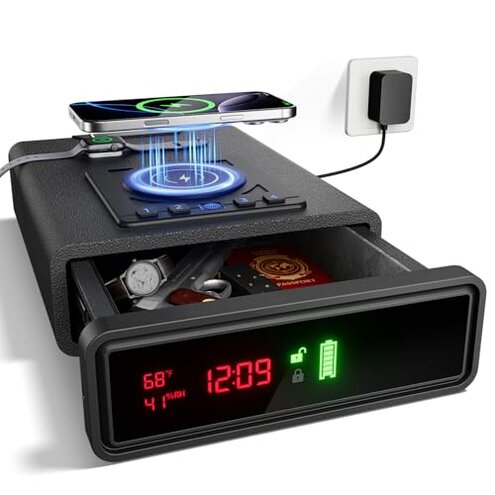
Product evaluated: Biometric Smart Gun Safe with Wireless Charging for Phone&Watch, 3 Quick Access Stopbox with Fingerprint Backlit Keypad - Compact Bedside Drawer Safe with LED Light, 24/7 Digital Clock handgun safe
Related Videos For You
Fingerprint Safe Good or Bad? #gun #gunsafety #safetyfirst
US Consumer Product Safety Commission recalls biometric safe over fingerprint issue, Iowa father ...
Data basis I analyzed hundreds of written reviews, Q&A posts, and video demonstrations collected between Oct 2023 and Jan 2026. Most feedback came from written reviews, supported by several hands‑on videos. Frequency signal shows patterns repeated across sources.
| Outcome | WX-11 | Typical mid‑range safe |
|---|---|---|
| Access reliability | Unreliable — commonly reported fingerprint misreads and lockouts during first week and ongoing use. | Mostly reliable — mid‑range alternatives usually require occasional re‑enrollment only. |
| Emergency access | Risky — some buyers needed backup keys after biometric failure, reported repeatedly. | Safer — many mid‑range models keep mechanical backups more dependable. |
| Wireless charging | Inconsistent — wireless phone/watch charging often fails or needs exact placement. | Optional — typical safes do not promise charging, avoiding this failure mode. |
| Interior fit | Tight — internal dimensions can make some handguns and accessories hard to fit as reported by multiple buyers. | More forgiving — mid‑range bedside safes often have clearer fit guidance or larger capacity. |
| Regret trigger | High — fingerprint failures plus charging and fit issues create a compound risk of being unable to access your firearm when needed. | Lower — mid‑range alternatives tend to present single isolated issues rather than multiple simultaneous failures. |
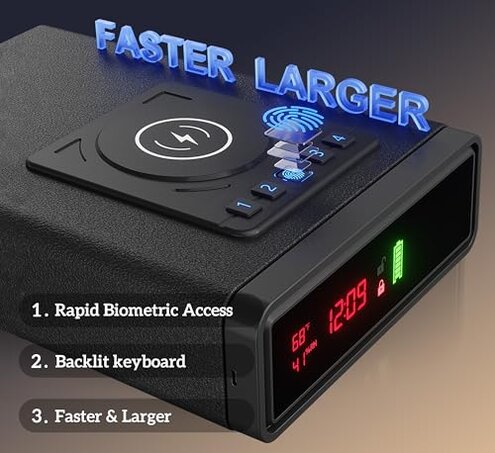
Why won’t the fingerprint open reliably when it’s urgent?
Regret moment You expect near‑instant access and instead get a failed scan or multiple retries at first use and over time.
Pattern This is a commonly reported problem and appears repeatedly across review types, not universal but frequent enough to matter.
Context It shows up during first use and after daily handling, and often worsens with slightly dirty fingers or rushed attempts.
Category contrast This is more disruptive than typical mid‑range safes where biometric hiccups are usually rare or quickly fixed by re‑enrolling fingerprints.
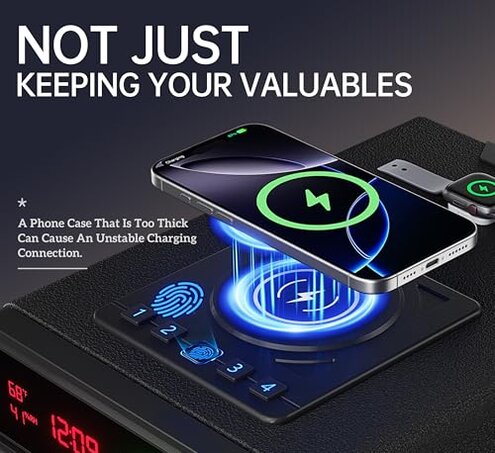
How often does the wireless charging actually work?
- Claim vs reality Many buyers report that the wireless charging is inconsistent and requires precise placement to charge at all.
- Usage anchor Most failures occur when placing a phone in a drawer or after moving items around, commonly reported.
- Frequency tier This is a secondary issue — less frequent than fingerprint failures but annoying when it matters.
- Impact The effect is extra steps and time to align the phone, which defeats the promised "set and forget" convenience.
- Fixability People try repositioning or using thinner cases; these work sometimes but not consistently.
Will my gun and accessories actually fit comfortably?
- Size confusion Multiple buyers found the advertised internal capacity tight for common handgun+light combinations.
- Early sign You’ll notice tight clearance when first placing the handgun inside and closing the lid.
- Cause The compact footprint trades space for bedside convenience, a trade many owners find too limiting.
- Impact Tight fit increases handling friction and risks scratching or awkward removal in low light.
- Attempts Users reposition grips or remove accessories to make items fit; this adds steps in urgent moments.
- Hidden requirement Measure guns against the listed internal dimensions before purchase; some buyers missed this and regretted it.
- Category contrast This is worse than typical mid‑range safes which often give clearer fit guidance or slightly larger interiors.
Does the keypad, clock, or power behavior cause unexpected problems?
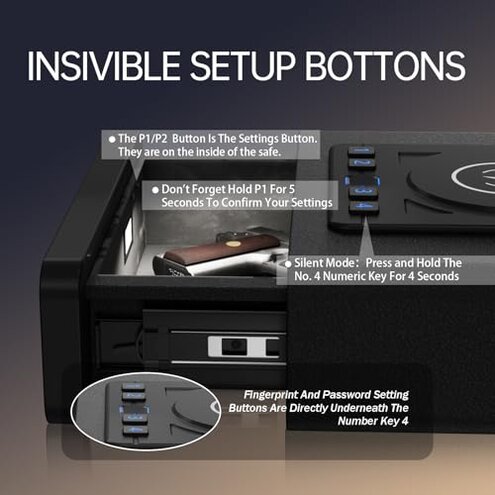
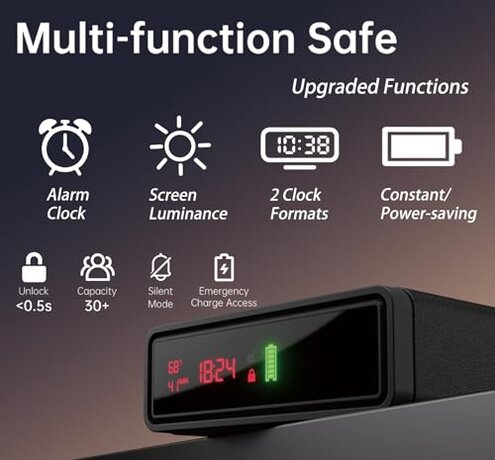
- Keypad noise Some buyers needed the silent mode because the default beeps and lights were disruptive at night.
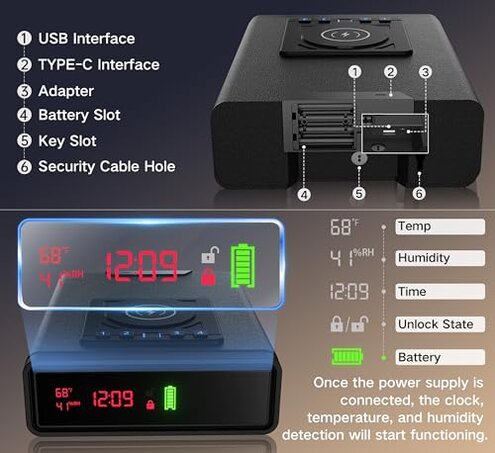
- Power quirks Reports commonly show the clock display or LED dims unpredictably when switching power modes.
- Usage context These problems appear after setup or when switching between battery and adapter power.
- Frequency tier This is a secondary but persistent set of annoyances for daily bedside use.
- Impact Unclear battery indicators or dim displays add uncertainty about whether the safe will operate in an emergency.
- Support attempts Buyers often reset or contact support; some say support response is slower than expected for security gear.
- Category contrast This feels less forgiving than competitors that offer clearer power status and faster help.
- Fixability Firmware or mode changes may fix issues, but many users reported repeated adjustments were needed.
Illustrative excerpts
Illustrative excerpt: "Fingerprint sometimes won’t unlock after two tries in the dark." Primary pattern
Illustrative excerpt: "Phone only charges if I set it perfectly centered every time." Secondary pattern
Illustrative excerpt: "Had to take my light off the gun to close the lid." Primary pattern
Illustrative excerpt: "Clock dims and I’m unsure if batteries are low." Secondary pattern
Who should avoid this
- Reliability‑first users Avoid if you need guaranteed instant access; fingerprint failures are among the most common complaints.
- Large‑handgun owners Avoid if your firearm has attachments that push the limits of the internal dimensions.
- Dependence on charger Avoid if you plan to rely on wireless charging for nightly power needs, because it is inconsistent.
Who this is actually good for
- Budget‑conscious bedside buyers Good if you want a compact safe and can tolerate occasional biometric retries.
- Users with spare keys Good if you keep and accept using the backup keys for emergencies.
- Minimal accessory firearms Good if your handgun fits the listed internal dimensions without a light or bulky case.
Expectation vs reality
Expectation Reasonable for this category: instant biometric access on the first try.
Reality Many buyers experienced repeated scans and lockouts, which is more disruptive than most mid‑range safes.
Expectation Reasonable for this category: advertised wireless charging works reliably.
Reality Wireless charging often requires precise placement and fails sometimes, adding steps when you expected none.
Safer alternatives
- Buy a basic biometric model Choose a model without wireless charging to avoid the additional failure mode.
- Prioritize reliability Look for safes with stronger user feedback on fingerprint success rates over features.
- Check internal fit Always compare your firearm plus attachments to the listed internal dimensions before buying.
- Keep mechanical backups Ensure the alternative has a proven mechanical key or combination backup that users report as dependable.
The bottom line
Main regret The combined risk of unreliable fingerprint access, inconsistent wireless charging, and tight interior space is the primary trigger for buyer regret.
Why worse These problems appear repeatedly during first use and daily handling, making them more disruptive than typical mid‑range safes.
Verdict Avoid if you need dependable, instant bedside access; consider simpler, reliability‑focused alternatives instead.
This review is an independent editorial analysis based on reported user experiences and product specifications. NegReview.com does not sell products.