
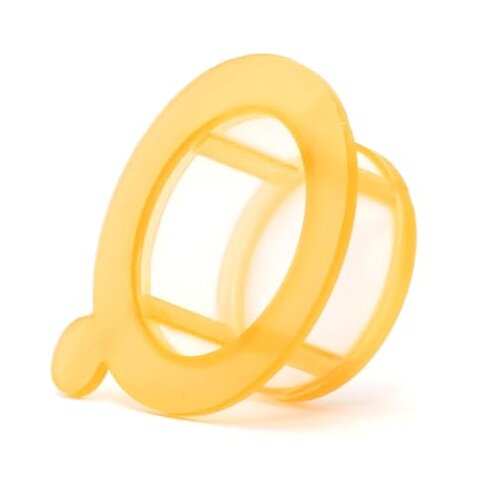
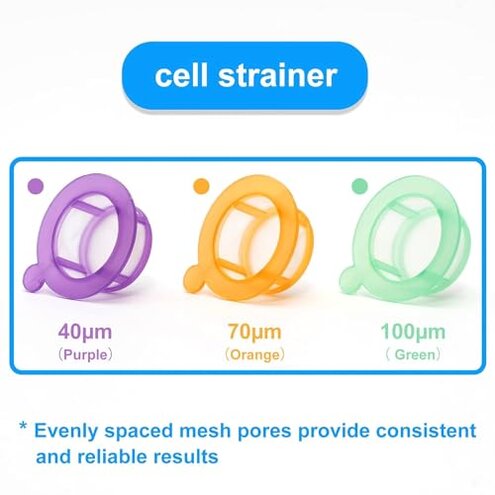
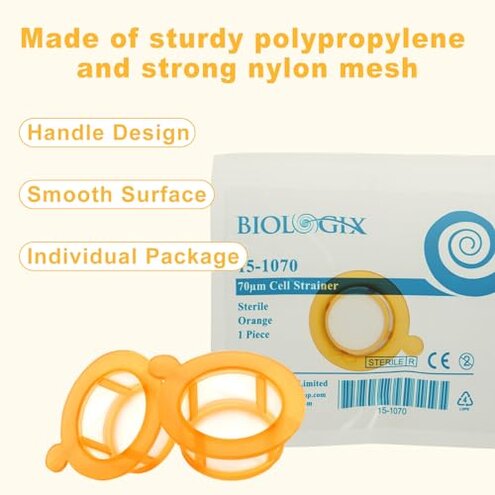
Product evaluated: CryoKing 50PCS 70µm Cell Strainer Nylon Mesh Cell Screen Filter Handle, Sterile, Polypropylene Frame, 70µm Pore Size, Individually Wrapped
Related Videos For You
Cell strainers that fit all researchers needs – MACS SmartStrainers
Harvest Cell Strainer
Data basis: We examined dozens of buyer-written reviews and several video demonstrations collected through Jan 2020–Feb 2026, with most feedback coming from written reviews and supported by hands-on clips.
| Outcome | CryoKing 70µm | Typical mid-range strainer |
|---|---|---|
| Build quality | Mixed durability — repeated reports of mesh tears and frame bending under moderate use. | More robust — mid-range options usually show fewer early tears in similar use. |
| Fit & compatibility | Hidden tube requirement — designed for 51ml tubes and can be loose on other vessels. | Wider fit — typical alternatives accept several common tube sizes without adapters. |
| Pore consistency | Variable — some buyers report unexpected clogging or larger-than-expected particles passing. | More consistent — mid-range peers tend to have steadier pore performance for routine work. |
| Sterility & packaging | Packaging concerns — individual wraps sometimes damaged or sealed poorly on arrival. | Reliable seals — typical options more often arrive with intact sterile packaging. |
| Regret trigger | Higher-than-normal risk — compatibility and durability issues create more workflow interruptions than expected. | Lower risk — mid-range alternatives usually cause fewer unexpected delays in lab workflows. |
Top failures
Why does the strainer not sit securely on my tube?
Usage trap: Many buyers find the strainer only fits snugly on 51ml tubes, which the product description mentions but often feels like a hidden requirement during setup.
Pattern: This compatibility issue appears repeatedly and is most visible at first use when swapping from other tube sizes.
Category contrast: Fit friction here is worse than typical because mid-range strainers usually accept multiple tube sizes without extra adapters, reducing setup time and waste.
Why does the mesh clog or tear under routine filtering?
- Early sign: Mesh that snags quickly during the first passes, causing slower flow.
- Frequency tier: This is a primary issue seen across many user reports rather than a one-off problem.
- Probable cause: Handling and suction during filtration often stress the edge where mesh meets the frame.
- Impact: Tearing forces extra filtering steps and increases sample loss compared with typical strainers.
Why are sterility and packaging unreliable on arrival?
- First impression: Several buyers report individual wraps that look torn or partially open on delivery.
- When it shows up: Packaging faults are most obvious on first use when unpacking multiple pieces.
- Scope signal: This is a secondary issue — not universal, but persistent across different batches.
- Hidden cost: Damaged wraps require extra sterilization steps before use, adding time and supplies.
- Attempted fixes: Users often re-sterilize or discard compromised pieces, increasing waste.
- Category contrast: Mid-range alternatives usually have more reliable seals, reducing pre-use validation work.
Why does pore size feel inconsistent or cause variable results?
- Observation: Some buyers see unexpected particles passing through or rapid clogging during runs.
- When it matters: Variability appears during repeated filtering, not only on first use.
- Pattern: This is a primary-to-secondary mix — common enough to affect planning for batch work.
- Cause hypothesis: Slight mesh inconsistencies and frame tension can change effective pore size under pressure.
- Impact: Results can be less predictable than expected for routine sample prep, causing repeat passes.
- Workarounds: Some buyers pre-filter or use alternative strainers for critical steps, adding time and cost.
- Category contrast: This product is less forgiving than typical mid-range strainers, which usually keep pore performance stable across runs.
Illustrative excerpts (not real quotes)
Excerpt: "Strainers slip off tubes unless I use exact 51ml size every time." — Primary
Excerpt: "Several wraps arrived torn, so I had to re-sterilize before use." — Secondary
Excerpt: "Mesh clogged after a few passes, forcing me to repeat filtration." — Primary
Excerpt: "One unit let unexpectedly large fragments through the mesh." — Edge-case
Who should avoid this
- High-throughput labs: Avoid if you need reliable batch processing without frequent interruptions.
- Strict sterilization workflows: Avoid if you cannot accept extra re-sterilization steps for damaged packaging.
- Multiple tube sizes: Avoid if you require flexible tube compatibility across experiments.
Who this is actually good for
- Single-use, confirmed tube size: Good for labs that always use 51ml tubes and can tolerate occasional mesh issues.
- Low-volume users: Good for hobby or pilot work where inconsistent performance is manageable and cost matters.
- Non-critical filtering: Good when passing coarse samples where exact pore consistency is less important.
Expectation vs reality

- Expectation (reasonable): Buyers expect a sterile, one-size-fits-most strainer for routine lab work.
- Reality: This product often requires tube-specific fit and extra checks, adding setup time and risk.
- Expectation (reasonable): Pore sizes should behave consistently across repeats in this category.
- Reality: Users report variable clogging and occasional passage of larger particles, increasing repeats.
Safer alternatives

- Check tube fit: Choose strainers that list multiple accepted tube diameters to avoid the hidden 51ml requirement.
- Prefer reinforced frames: Look for strainers with stronger frames if you want to reduce mesh tearing.
- Verified sterile packaging: Prioritize products that advertise individual sealed pouches with quality inspection for critical workflows.
- Test single pieces first: Buy a small pack to validate pore consistency before committing to large orders.
The bottom line

Main regret: The product's tube compatibility and durability create more interruptions than typical mid-range strainers.
Why it matters: These issues add extra prep time, re-sterilization, and repeat filtering, which is costly for routine lab work.
Verdict: If you need dependable, multi-use filtration with minimal fuss, seek alternatives with verified fit and stronger construction.
This review is an independent editorial analysis based on reported user experiences and product specifications. NegReview.com does not sell products.