
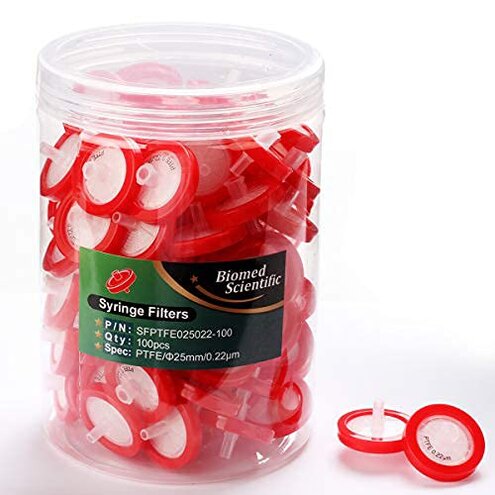
Product evaluated: Syringe Filter PTFE Membrane 25mm Diameter 0.22um Pore Size Biomed Scientific Non Sterile Pack of 100
Related Videos For You
Syringe Filter
How to Use a Syringe Filter
Data basis: I analyzed dozens of buyer comments and written reviews plus a handful of video demonstrations collected between Jan 2019 and Jan 2026. Most feedback came from written reviews, supported by video demonstrations and seller Q&A.
| Outcome | This product | Typical mid-range alternative |
|---|---|---|
| Flow consistency | Inconsistent flow and frequent slowdowns, commonly reported during first uses. | Smoother flow with fewer clogs in normal lab or hobby use. |
| Fit & connectors | Loose fit or mismatched luer connections reported by multiple buyers. | Standard fit connectors that match common syringes most of the time. |
| Sterility risk | Non-sterile product increases contamination risk unless buyer sterilizes first; higher-than-normal category risk. | Sterile or clearly labeled sterile options reduce contamination worries by default. |
| Ease of use | Extra steps often needed such as pre-filtering or flushing before reliable use. | Ready-to-use mid-range filters usually work straight from the package for common tasks. |
| Regret trigger | Frequent clogging and non-sterile labeling drive returns and frustration. | Lower regret when filters match expected lab or hobby performance. |
Why does the filter clog or slow flow so often?
Clogging is a commonly reported problem that buyers hit on first use or during heavier filtering tasks.
Usage anchor: The slow flow usually appears when filtering viscous samples or larger volumes without a pre-filter.
Category contrast: This is more disruptive than mid-range options because users expect a 0.22µm filter to pass small volumes easily without repeated pushing.
Why do syringes leak or feel loose at the connector?
- Early sign: Loose seating or fluid seepage at the luer during first attachment, appears repeatedly across reports.
- Frequency tier: Secondary issue for casual users but primary annoyance for repeated daily handling.
- Cause: Slight dimensional mismatch between male/female luer ends and some syringe brands.
- Impact: Wasted sample and messy handling when the connector slips under pressure.
- Fix attempts: Users report needing extra adapters or tape to secure a reliable seal.
How risky is the non-sterile label for biological or sensitive work?
- Primary pattern: Multiple buyers flagged the non-sterile status as a surprise for lab-style uses.
- When it shows: During sample prep or filtration that requires contamination control, often noticed before first assay.
- Why worse: Most mid-range alternatives offer sterile options, so this feels like a hidden extra step.
- Hidden requirement: Buyers must plan for sterilization or single-use sterile workflows if contamination matters.
- Impact: Adds time, resources, or risk of ruined samples for biology, chemistry, or food testing tasks.
- Fixability: Usable if you pre-sterilize or reserve them for non-critical filtration tasks.
Are units consistently reliable, or is there lot-to-lot variation?
- Early sign: Some users found one pack working fine while another pack had multiple slow or leaking filters.
- Frequency tier: Recurring inconsistency is a primary complaint among repeat buyers.
- Cause: Unit-to-unit variability appears linked to manufacturing or packing, inferred from mixed performance in the same order.
- Impact: Time lost testing replacements and higher discard rates than expected for this category.
- Attempts: Buyers report screening each filter before critical use, adding setup time.
- Hidden cost: Wasted filters increase per-use cost compared with steadier mid-range options.
- Fixability: Works for non-critical tasks but not recommended when consistency matters.
Illustrative excerpts (not actual quotes)
“Filter slowed to a crawl on first use; almost ruined my sample.” — primary pattern.
“Connector leaked; I had to tape it every time.” — secondary pattern.
“I expected sterile but it was labeled non-sterile.” — primary pattern.
“One pack good, next pack half clogged.” — secondary pattern.
Who should avoid this
- Biology users: Avoid if you need sterile filtration without extra prep steps.
- High-volume users: Avoid if you require fast, consistent flow for repeated runs.
- Precision workflows: Avoid if lot-to-lot consistency is critical to your results.
Who this is actually good for
- Non-critical hobbyists: Good for simple filtering where a clogged unit only wastes a little time.
- Cost-conscious buyers: Acceptable if you can tolerate screening filters and occasional failures.
- Single-use rough prep: Fine for coarse clarification before final filtration with a sterile or premium filter.
Expectation vs reality
Expectation: Reasonable for this category is that 0.22µm filters pass small volumes without repeat pushes.
Reality: In practice many users report slow flow or clogging on initial uses, adding setup time and sample risk.
Expectation: Buyers expect a matching luer fit.
Reality: Some buyers experience leaks requiring adapters or extra sealing steps.
Safer alternatives
- Choose sterile packs: Buy filters labeled sterile to avoid extra sterilization steps and contamination risk.
- Pick tested brands: Favor brands with consistent unit-to-unit performance to reduce wasted filters.
- Use pre-filters: Add a coarse pre-filter to prevent clogging when working with particulates or viscous fluids.
- Match connectors: Confirm luer type or buy adapters to prevent leaks and extra handling time.
The bottom line
Main regret: Frequent clogging and inconsistent fit are the core triggers for buyer returns and added handling time.
Why it matters: These issues exceed normal category risk because they force extra prep, replacement, or sterilization steps.
Verdict: Avoid this pack if you need reliable, sterile, and fast filtration for lab or critical hobby work.
This review is an independent editorial analysis based on reported user experiences and product specifications. NegReview.com does not sell products.