
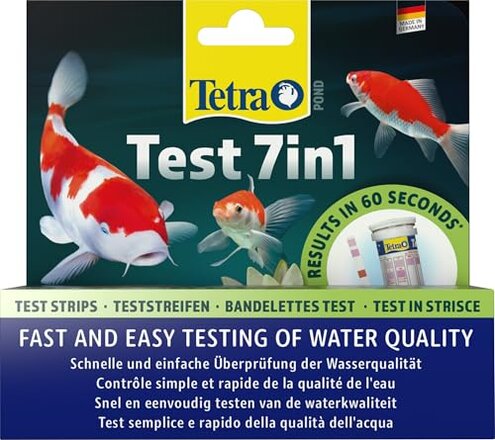
Product evaluated: Tetra Pond Test 7-in-1 Water Test for The Pond, Quick and Easy Checking of Water Quality in The Garden Pond, 1 Can (25 Test Strips)
Related Videos For You
How To Test with "API Fish Care 5 in 1 Pond Test Strips"
How to Clear Up Dirty Pond Water - TESTING WITH RESULTS
Data basis: I reviewed dozens of buyer reports and Q&A posts collected between 2023–2025, using written reviews and video demonstrations as sources. Most feedback came from written reviews, supported by images and short videos, with repeat patterns visible across sources.
| Outcome | Tetra Pond Test | Typical mid-range test strips |
|---|---|---|
| Accuracy | Variable readings that often conflict with other checks. | Generally consistent within expected banding and repeatable. |
| Ease of use | Simple single dip, but color matching is often subjective. | Similar procedure but easier color guides or digital readers exist. |
| Hidden steps | Requires phone app or extra interpretation for best results. | Usually works standalone without extra apps. |
| Regret trigger | High risk of misleading readings at critical moments like algae blooms. | Lower chance of surprise because results track better with manual tests. |
| Cost per test | Higher effective cost due to repeat testing and retests. | Lower waste when results are consistent first try. |
Are the readings inconsistent or confusing?
Regret moment: You test because water looks off, and the strip gives a conflicting result that mismatches other checks. This is a primary complaint; it appears repeatedly in reports.
When it happens: Inconsistent readings appear on first use and after storage, and they worsen with murky or colored pond water.
Why worse than normal: Unlike typical mid-range strips, this product is reported as more variable across uses, which forces extra retests and guesswork.
Is matching the strip color to the chart difficult?
- Early sign: Colors look faint after 60 seconds and can be hard to compare to the printed chart.
- Frequency tier: This is a secondary but commonly noted frustration among buyers.
- Cause: Pond water tint and lighting often shift perceived colors versus the chart.
- Impact: Hard-to-read colors lead to wrong treatment choices for pH, nitrite, or chlorine.
- Fixability: Using a white background and consistent light helps, but buyers still report repeat uncertainty.
Do strips degrade, expire, or give bad results after storage?
- Pattern: Reports show this as a persistent issue for some buyers, especially when cans sit open.
- When: Problems appear after storage or if the foil can is left unsealed.
- Why it matters: Degraded strips create false negatives or muted color changes.
- Category contrast: More fragile than many mid-range strips that tolerate brief exposure.
- Hidden cost: You often have to discard affected strips, increasing cost per valid test.
- Attempts: Buyers tried resealing the can and using desiccant, with mixed success.
Does the app or instructions hide extra steps and limits?
- Hidden requirement: Best-read results are often tied to using the smartphone app mentioned in the package.
- Scope: This appears across multiple feedback types and is a secondary pattern.
- When it matters: The extra step shows up at the moment you want a quick manual read.
- Impact: Needing a phone adds time and excludes buyers without compatible devices.
- Workaround: Some buyers photograph strips and compare colors on-screen, which adds effort.
- Category contrast: Many mid-range options are fully standalone and don’t rely on apps.
- Fixability: Training and consistent lighting help, but the app dependence remains a limitation.
Illustrative excerpts (not real quotes)
Illustrative: "Strip color barely changes; pH seems wrong compared to my meter." — primary pattern.
Illustrative: "Can left open one week and half the strips were useless." — secondary pattern.
Illustrative: "Had to use the app to make sense of the chart, extra step I didn't want." — edge-case pattern.
Who should avoid this
- Precision seekers: Avoid if you need repeatable numeric accuracy for pond treatments.
- Low-effort users: Avoid if you want one-step readings without apps or retests.
- Budget trackers: Avoid if you can't tolerate wasted strips that raise cost per valid test.
Who this is actually good for
- Quick spot-checkers: Good for users who accept rough band results and visual confirmation.
- Occasional testers: Works if you test infrequently and don't need exact numbers.
- App-friendly users: Useful if you want to use the smartphone app to interpret ambiguous colors.
Expectation vs reality
- Expectation: Reasonable for this category is a quick, readable color match after one dip.
- Reality: Many buyers find matches are uncertain and require retests or app help.
- Expectation: Reasonable mid-range strips remain stable in short-term storage.
- Reality: This product shows higher fragility if cans are left open or stored poorly.
Safer alternatives
- Choose digital readers: Look for testers with a digital readout to avoid subjective color matching.
- Prefer sealed packs: Buy strips that come in individually sealed sachets to reduce degradation.
- Match your need: If you need precision, pick meter-style kits rather than banding strips.
- Check compatibility: Avoid app dependence by choosing kits that are standalone.
The bottom line
Main regret: The most common trigger is inconsistent and subjective readings that push buyers to retest or mis-treat ponds.
Why worse: This product shows higher-than-normal variability and hidden app steps compared with typical mid-range strips.
Verdict: Avoid if you need reliable, single-step results; consider meters or sealed-strip alternatives for lower risk.
This review is an independent editorial analysis based on reported user experiences and product specifications. NegReview.com does not sell products.