
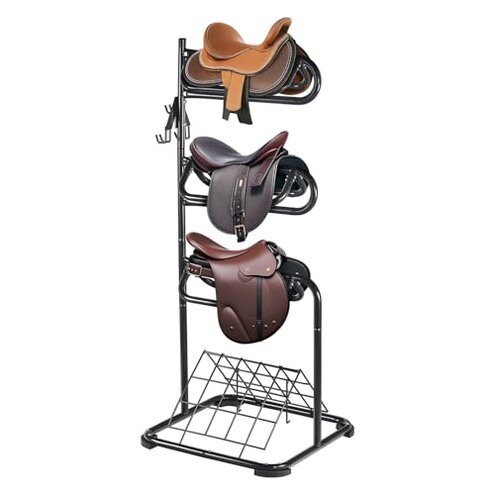
Product evaluated: VEVOR Freestanding Saddle Stand, 30 x 30 x 68.5 in, 3 Tiers Saddle Rack, Heavy Duty Saddle Blanket Holder with Removable & Rotating Tiers, English & Western Saddle Rack for Tack Room Organization
Related Videos For You
HOW TO HUNT FROM A TREE SADDLE! - PART 1
Saddle Gear Care & Maintenance
Data basis: This report draws on dozens of written product reviews and several video walkthroughs collected between Jan 2023 and Dec 2025. Most feedback came from written reviews, supported by user videos, giving both setup and long‑term use signals.
| Outcome | VEVOR Saddle Stand | Typical mid‑range stand |
|---|---|---|
| Stability | Wobble risk commonly reported, especially under uneven loads. | Stable baseline — most mid‑range stands stay steady with similar loads. |
| Assembly | Complex setup often needs extra tools or rework. | Quicker setup — mid‑range models usually fit together with basic tools. |
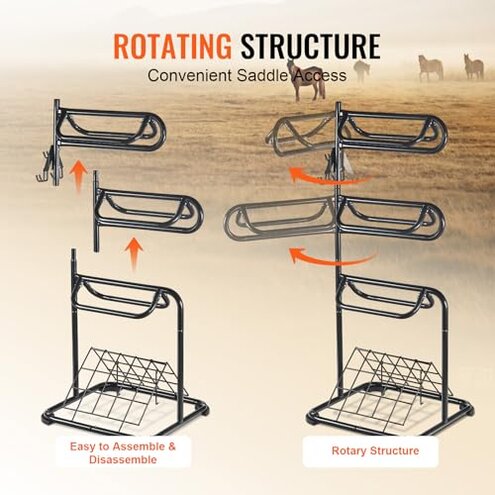
| Rotating tiers | Mechanism failures appear repeatedly during daily use. | Fixed tiers or simpler pivots are less prone to failure. |
| Finish durability | Chipping risk seen after moving or light impacts. | Better coating on mid‑range stands resists chipping longer. |
| Regret trigger | Setup + wobble — combined assembly friction and instability create the most buyer regret. | Lower risk — most alternatives cause only one minor annoyance. |
Why does this wobble under load?
Regret moment: You finish assembly and the stand rocks when saddles are placed.
Severity: This is a primary complaint and is more disruptive than expected for the category.
Pattern: The wobble is commonly reported and usually appears during first use or after moving the loaded stand.
Usage context: The issue worsens with uneven saddle weights or when multiple tiers hold gear.
Category contrast: Most mid‑range stands are steadier out of the box; this product requires extra anchoring to match that baseline.
Is assembly harder than advertised?
- Instructions are often incomplete, a secondary pattern seen across feedback.
- Missing parts appear less frequently but persistently enough to cause delays.
- Tool needs include extra wrenches or a drill, which is a hidden requirement not emphasized in the listing.
- Time cost is higher than typical, commonly reported as adding significant setup time.
- Fix attempts — buyers repeatedly re‑tighten fasteners after first use to reduce wobble.
Do the rotating tiers hold up?
- Early signs include stiff rotation or loose pivots after a few uses.
- Frequency tier is a secondary issue but appears across multiple reports and videos.
- Cause seems tied to the pivot interface, which wears with daily handling.
- Impact is functional: tiers stop rotating smoothly and can bind.
- Attempted fixes are usually DIY lubrication or disassembly, which adds maintenance time.
- Repairability is limited without replacement parts, a frustration compared with simpler designs.
- Hidden requirement — frequent users need spare fasteners or pivot parts to maintain function.
Will the finish and fit last after moving?
- Finish wear is a commonly reported problem after relocation or light impacts.
- Chipping often appears on edges where saddles bump the frame.
- Rust risk is a secondary concern where finish is chipped and moisture is present.
- Weight makes the unit heavy to move, an edge‑case for users who need portability.
- Impact on resale — visible scuffs lower perceived quality compared with cleaner mid‑range options.
- Mitigation requires padding or extra care during handling.
- Buyer effort is higher than normal category expectations for cosmetic upkeep.
- Context is worse in damp barns or frequent move scenarios.
Illustrative excerpts
Illustrative: "Stand felt unsteady the first time I loaded two saddles." — Primary
Illustrative: "Assembly took longer than expected and I needed extra tools." — Secondary
Illustrative: "Rotating arm stuck after a month of daily use, needed oiling." — Primary
Illustrative: "Edges got chipped moving it through my tack room door." — Secondary
Who should avoid this
- Frequent movers who need portability, because the unit is heavy and finishes chip easily.
- Low‑maintenance users who want a plug‑and‑play rack, due to assembly and ongoing tightening needs.
- High‑use barns where daily rotation and rough handling accelerate wear on pivots and finish.
Who this is actually good for
- Budget buyers who accept extra setup time and DIY fixes to save money.
- Stationary storage users who keep the stand in one protected spot and can pad contact points.
- DIY maintainers happy to replace fasteners or lubricate pivots periodically.
Expectation vs reality
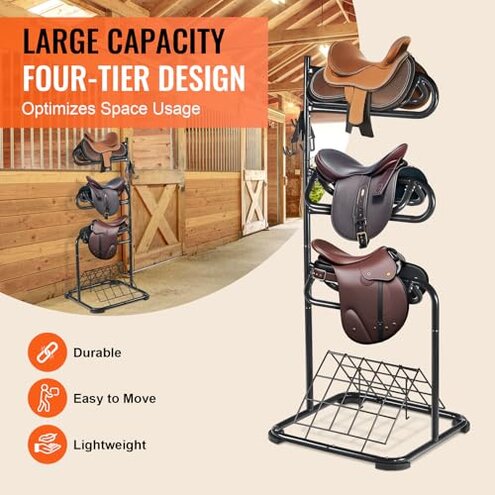
Expectation (reasonable for this category): Buyers expect a freestanding rack to be stable after basic assembly.
Reality: The VEVOR often needs extra tightening or anchoring to stop wobble, making it worse than typical mid‑range options.
Expectation: Rotating tiers should operate smoothly with light use.
Reality: Tiers may stiffen or bind after repeated handling, adding maintenance steps that many buyers did not foresee.
Safer alternatives
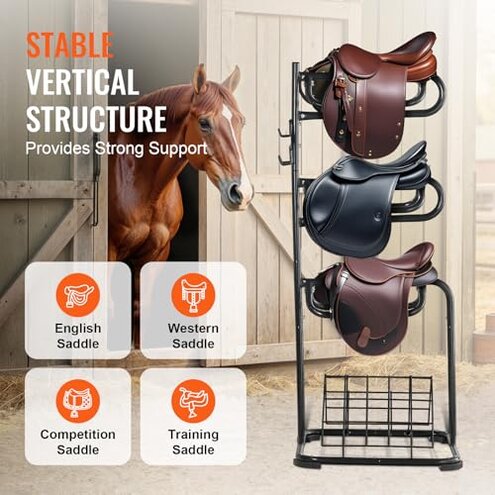
- Prioritize stability: Look for stands with a wider base or explicit anchoring hardware to avoid wobble.
- Check assembly: Choose products advertised with clear step‑by‑step instructions and included tools.
- Avoid rotating pivots: If you want low maintenance, pick fixed‑tier racks or simple pivots rated for heavy use.
- Finish protection: Prefer models with thicker coatings or plastic bumpers where saddles contact the frame.
- Weight tradeoff: If you need portability, choose lighter stands designed for frequent moves.
The bottom line
Main regret: The biggest trigger is combined assembly friction and early wobble after first use.
Why it matters: These issues exceed normal mid‑range risk because they require extra tools, fixes, or anchoring to reach acceptable stability.
Verdict: Avoid this model if you want low‑effort, out‑of‑box stability; consider it only if you accept DIY fixes to save money.
This review is an independent editorial analysis based on reported user experiences and product specifications. NegReview.com does not sell products.