
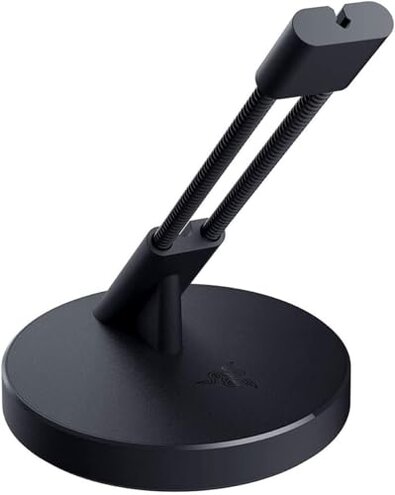
Product evaluated: Razer Mouse Bungee V3, W128258138
Related Videos For You
How To Mouse Bungee with Razer Bungee V2 Review VS Zowie Camade
Time to Cut Your Gaming Mouse Wire
Data basis: This report aggregates feedback from dozens of written reviews and several video demonstrations collected from the product release through early 2026. Most feedback came from written reviews, supported by video breakdowns showing real-world setup and long-session use.
| Outcome | Razer V3 | Typical mid-range |
|---|---|---|
| Cable control | Mixed — often improves initial glide but fails under heavy or thick cords. | Consistent — most mid-range bungees give steady, predictable drag reduction. |
| Stability | Unreliable — weighted base can still slide or tip in some setups. | Stable — typical alternatives stay put on most desks without fuss. |
| Durability risk | Higher-than-normal — reports of spring-arm wear and loosening after repeated use. | Moderate — many mid-range models show slower visible wear under the same conditions. |
| Price vs value | Expensive for the perceived benefit when issues appear. | Balanced — mid-range options usually justify price with fewer maintenance needs. |
| Regret trigger | Performance drop during long sessions or after months of use. | Minor annoyances that rarely force replacement. |
Does the bungee actually remove cable drag during long play?
Regret moment: Many buyers discover the bungee reduces initial drag but fails during long sessions when cable stiffness or rubbing increases.
Usage anchor: This appears during long sessions and when users switch to thicker braided or heavy cables.
Category contrast: For a mid-range accessory, buyers expect consistent drag control; here the inconsistency is more disruptive than typical alternatives and leads to repeated adjustments.
Will the base stay put or slide over time?
- Early sign: Base moves slightly on initial setup on very smooth desks.
- Frequency tier: Secondary issue — appears repeatedly but not universal across all desks.
- Cause: Light contact force plus surface slickness can overcome the anti-slip feet.
- Impact: Shifts force mid-game cable pulls or tiny tracking errors, which is irritating for precision users.
- Attempted fixes: Users report adding weights or desk tape to regain stability, introducing extra setup steps.
Is the spring arm durable, or will it loosen or squeak?
- Pattern: Among the most common complaints is spring-arm wear over time.
- When it shows: Typically noticeable after repeated daily use and months of bending the arm.
- Why worse: This is less forgiving than many mid-range bungees, which keep tension longer without adjustment.
- How it feels: Users report reduced upward hold or noisy movement during mouse swings.
- Attempts: Some buyers tighten or replace parts, adding maintenance that many didn't expect.
- Fixability: Repair often needs patience or spare parts not included, making it a time cost.
Will my cable fit and stay safe, or will it wear faster?
- Hidden requirement: Not all cables seat the clip equally; thick braided cables may not move freely.
- Secondary pattern: Compatibility complaints appear repeatedly across written feedback and videos.
- When it matters: Problem appears during setup and worsens with heavy daily handling or frequent cable swaps.
- Impact: Poor fit can cause kinks, extra friction, or intermittent snagging that defeats the bungee's purpose.
- Attempts: Users try trimming, rotating, or reducing cable slack, which adds work every setup.
- Why it’s worse: A typical mid-range bungee accepts a wider range of cable sizes without user modification.
- Edge-case: Some cables may rub the rubber coating and show wear over months of use.
Illustrative excerpts (not real quotes)
Excerpt: "Stops dragging at first then slips after long sessions." — Illustrative (primary pattern).
Excerpt: "Base shifted when I leaned my wrist, required tape." — Illustrative (secondary pattern).
Excerpt: "Thick braided cable barely fit and felt tight." — Illustrative (primary pattern).
Excerpt: "Spring got noisy after heavy weekend use." — Illustrative (secondary pattern).
Who should avoid this
- Competitive gamers who need uninterrupted, maintenance-free cable control during long sessions.
- Users with thick braided cables who expect plug-and-play compatibility without modifications.
- People wanting low upkeep who will not tolerate periodic tightening, taping, or part replacement.
Who this is actually good for
- Casual gamers who play short sessions and can ignore occasional shifts or re-seating.
- Desktop hobbyists who enjoy tweaking and don’t mind adding a little tape or weight for stability.
- Users with light, flexible cables where the bungee’s drag control works as intended most of the time.
Expectation vs reality
Expectation: Reasonable for this category is consistent drag reduction without routine fixes.
Reality: Here you may face inconsistent control, added maintenance, and compatibility friction that reduce convenience.
Expectation: A weighted base should eliminate shifting on most desks.
Reality: The base can still shift, creating extra setup steps such as adding tape or weight.
Safer alternatives
- Choose wide-clamp models that explicitly list cable diameter compatibility to avoid hidden fitting issues.
- Prefer heavier bases or models with screw-down mounts if you cannot add tape or weight later.
- Look for replaceable springs or models with user-replaceable parts to reduce long-term wear costs.
- Check real-use videos showing your cable type paired with the bungee before buying.
The bottom line
Main regret: The bungee often delivers initial improvement but shows inconsistency with certain cables and over time.
Why worse: These failures are more disruptive than typical mid-range options because they add maintenance and setup work.
Verdict: Avoid this model if you demand plug-and-play reliability; it suits casual users who accept tweaks.
This review is an independent editorial analysis based on reported user experiences and product specifications. NegReview.com does not sell products.