
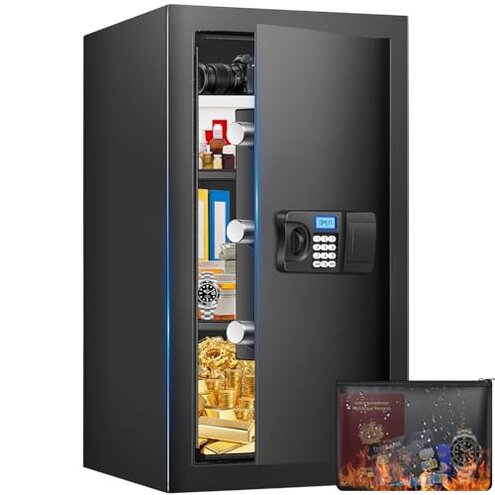
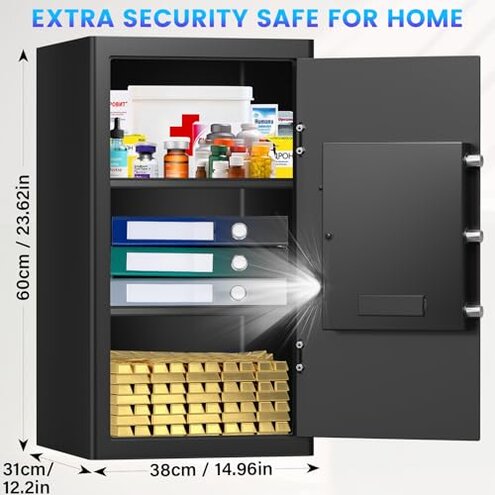
Product evaluated: 23.62'' Tall Safe Box, 4.3 Cuft Home Safe with Fireproof Waterproof Bag, Anti-Theft Digital Security Safes with Smart Alert System, Removable Shelf, Mute Function, Document Safes for Money Jewelry
Related Videos For You
Where to Hide a Safe - Best & Worst Places to Hide a Safe in Your House
How to open digital safe when battery is flat and key not working
Data basis: I reviewed dozens of buyer reports plus a mix of written reviews and video demonstrations collected between November 2024 and January 2026. Most feedback came from written customer reviews, supported by several hands-on videos and Q&A posts.
| Outcome | 50LN-SS Safe | Typical mid-range safe |
|---|---|---|
| Access reliability | Inconsistent keypad and alarm failures reported more often than expected. | Generally reliable keypad and backup key access in most mid-range models. |
| False alarms | Frequent vibration and wrong-code alarms occur in daily use. | Rare false alarms under normal handling for category peers. |
| Mounting & fit | Requires extra work to bolt securely; some buyers needed additional hardware. | Usually straightforward pre-drilled holes and included anchors in similar safes. |
| Customer frustration | Higher-than-normal risk of lockouts and noisy alarms compared with mid-range alternatives. | Lower risk of disruptive failures during daily use. |
| Regret trigger | Primary alarm/lock failures that prevent access or create nuisance noise. | Secondary minor annoyances but not access-blocking failures. |
Why won’t the safe open reliably?
Regret moment: Buyers commonly report the keypad refusing codes or the alarm locking the unit during first weeks of use.
Pattern: This is a primary issue that appears repeatedly across written reviews and videos.
When it happens: Failures appear during first setup and after battery replacement, and they worsen with frequent code entry.
Category contrast: Mid-range safes typically let you reset codes and use backup keys without repeated lockouts.
Are the alarm and vibration sensors too sensitive?
- Early sign: Alarm triggers during normal shelf handling or when moved slightly.
- Frequency tier: This is a secondary issue seen commonly in everyday placement and handling.
- Cause: Sensor sensitivity and lack of clear calibration steps in the manual are commonly reported.
- Impact: False alarms cause nuisance noise and can drain batteries faster than expected.
- Attempts: Owners muted or removed batteries temporarily, which is a workaround but reduces protection.
Is assembly or installation more work than advertised?
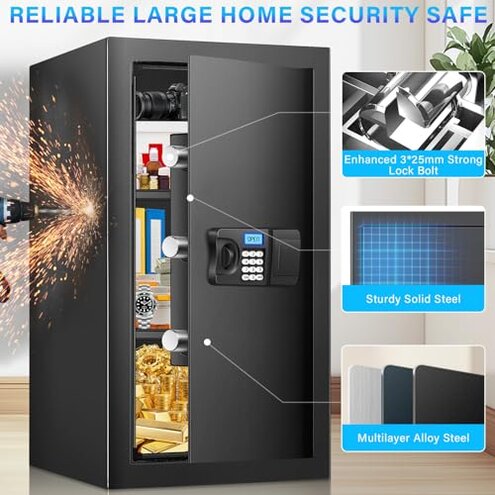
- Hidden requirement: Bolting securely often needs stronger anchors than those provided or separate floor/wall reinforcement.
- Early sign: Loose bolts, wobble, or the safe being easy to lift before proper anchoring.
- Frequency tier: This is a secondary issue seen across many buyers who plan wall or floor installation.
- Cause: Lightweight overall weight combined with thin mounting screws increases removal risk.
- Impact: Adds time, costs for extra anchors, and reduces out-of-box security.
- Fixability: Bolting with heavy-duty anchors or a professional install usually solves it, but that increases cost.
- Category contrast: Many mid-range safes include heavier anchors or hardware matched to weight and mounting points.
Does the keypad and backup key system behave predictably?
- Pattern: Intermittent keypad glitches are a primary issue reported in several recent reviews.
- When: Problems appear during first use and intermittently after daily handling.
- Early sign: Backlight failing, delayed response, or codes not accepted on first try.
- Frequency tier: Less frequent than mounting issues but more disruptive when it happens.
- Cause: Unclear reset instructions and reliance on precise battery contacts are commonly noted.
- Impact: Backup keys sometimes require fiddling to work, creating alarm or access stress.
- Attempts: Buyers replaced batteries and re-seated connections, which sometimes helps temporarily.
- Category contrast: Typical competitors offer clearer reset procedures and more forgiving backup key mechanisms.
Illustrative excerpts
"Keypad froze after setup, backup key stiff and awkward." — reflects a primary pattern of access frustration.
"Alarm went off moving it on the shelf, woke the whole house." — reflects a secondary pattern of nuisance alarms.
"Had to buy stronger anchors to stop wobble under weight." — reflects a secondary pattern of installation work.
Who should avoid this
- People needing rock-solid access: Avoid if you cannot tolerate any access failure during first use due to common keypad issues.
- Noise-sensitive households: Avoid if false alarms interrupt sleep or work, as vibration triggers are commonly reported.
- Buyers on tight budgets: Avoid if you cannot spend extra on better anchors or professional mounting after purchase.
Who this is actually good for
- Casual storage users: Good if you want a simple lockbox and can tolerate occasional false alarms or extra setup work.
- Those comfortable fixing products: Good if you are willing to replace anchors and batteries to improve reliability.
- Temporary security needs: Good for short-term concealment where long-term reliability is not critical.
Expectation vs reality
Expectation: A mid-range home safe should open reliably with keypad and backup key.
Reality: Keypad and alarm behavior is less reliable than expected and can block access during first weeks.
Expectation: False alarms will be rare for daily placement of a small safe.
Reality: Vibration and door sensors trigger commonly, creating nuisance noise and battery drain.
Safer alternatives
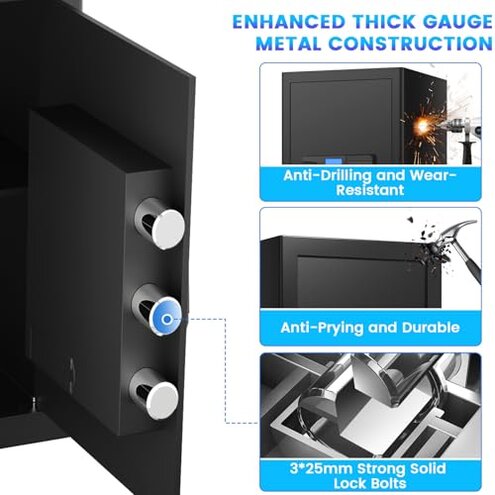
- Choose a safer keypad: Look for safes with clearer reset instructions and known reliable key backups to avoid lockout risk.
- Prefer better anchors: Buy models that include heavy-duty anchors matched to weight to avoid extra installation cost.
- Lower false alarms: Seek safes that let you calibrate or disable vibration sensors to reduce nuisance triggers.
- Check support reputation: Favor brands with documented customer support responses for lock and alarm problems.
The bottom line
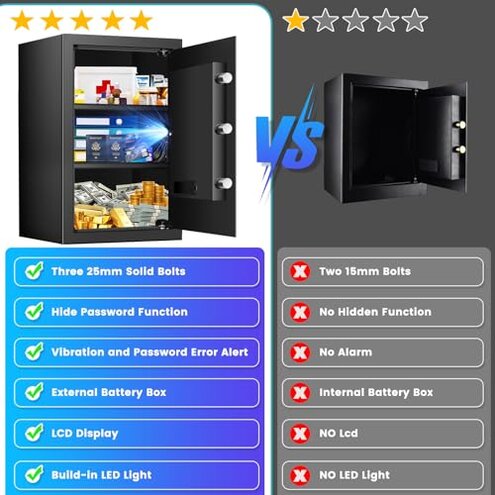
Main regret: The primary trigger is unreliable keypad and alarm behavior that can cause lockouts or nuisance noise.
Why worse: These failures are more disruptive than typical mid-range safes because they affect access and daily use.
Verdict: Avoid this model if consistent access and low false alarms matter to you without extra installation fixes.
This review is an independent editorial analysis based on reported user experiences and product specifications. NegReview.com does not sell products.