
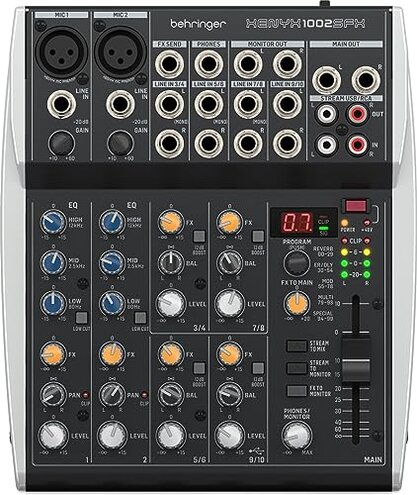
Product evaluated: Behringer Xenyx 1002SFX 10-channel Analog Streaming Mixer
Related Videos For You
Analog Mixer Basics (How to Use An Analog Mixer)
USB Audio Issues / Setup | Behringer Xenyx Audio Mixer
Data basis: This decision report is based on dozens of aggregated buyer signals collected from written ratings and long-form user notes, with support from short demo-style clips. The collection window spans the last 12 months. Most feedback came from text write-ups, with a smaller share from quick “show-it-working” style posts that helped confirm setup and daily-use pain points.
| Buyer outcome | Behringer Xenyx 1002SFX | Typical mid-range mixer |
|---|---|---|
| First-day setup | More fiddly and easier to mis-route audio. | More guided, fewer “why is this silent” moments. |
| Streaming convenience | Extra steps are commonly needed to get clean USB audio. | Smoother USB workflow is more typical. |
| Noise risk | Higher-than-normal chance of hiss or buzz in real rooms. | Lower noise floor is more common at this price. |
| Controls feel | Small knobs make repeatable levels harder. | More spacing and easier “set it once” control. |
| Regret trigger | Streaming audio not matching what you hear in headphones. | More predictable monitoring vs recorded output. |
Top failures
“Why doesn’t my stream sound like my headphones?”
Regret moment hits when you monitor a clean mix but the USB feed is wrong, quiet, or missing a source. This is a primary issue pattern that appears repeatedly, especially after initial setup.
Worsens when you switch between streaming apps, change sample settings, or add a second source mid-session. A typical mid-range mixer is usually more forgiving here, so the mismatch feels more disruptive than expected.
- Recurring pattern shows up when routing USB vs main mix isn’t intuitive.
- Early sign is “levels move” on the mixer but your app records silence.
- Trigger moment often happens during the first live test, not during dry setup.
- Hidden requirement is extra time learning what USB actually captures on this unit.
- User impact is redoing scenes, sources, and gain staging right before going live.
- Workarounds commonly include changing cabling and monitoring paths to confirm the feed.
- Fixability is mixed because the behavior can be “by design” once understood.
Illustrative: “Headphones are fine, but the recording is empty or weird.”
Explanation: This reflects a primary pattern tied to USB routing expectations.
“Why is there hiss or buzz when nothing is playing?”
Regret moment is hearing noise under your voice during quiet passages. This is a secondary issue that appears repeatedly, most often during daily use in real rooms.
- Common context is streaming or recording at night when background noise is noticeable.
- Scope signal shows up across different user setups, not one single use-case.
- Category contrast is that mid-range mixers often tolerate “normal” cabling with less fuss.
- Likely cause is sensitivity to gain settings and nearby power or USB noise.
- Worsens when you push mic gain higher to compensate for quiet microphones.
- Mitigation usually requires extra troubleshooting steps like isolating USB power paths.
- Residual risk is that some noise can remain even after cleanup attempts.
- Time cost is repeated A/B tests rather than a one-and-done fix.
Illustrative: “It’s fine until I raise the gain, then the hiss shows up.”
Explanation: This reflects a secondary pattern tied to gain-staging sensitivity.
“Why are the knobs so touchy when I try to dial in levels?”
Regret moment comes when small changes swing your level too much, so you keep chasing the sweet spot. This is a secondary issue that appears persistently once you do real sessions, especially with frequent adjustments.
- Repeat friction shows up when you adjust between songs, guests, or game audio.
- Early sign is bumping a control and losing a balance you had working.
- Category contrast is that many mid-range boards give more spacing for “hands-on” use.
- Session risk rises during long streams where you make lots of tiny changes.
- User impact is inconsistent loudness that listeners notice before you do.
- Mitigation often means marking knob positions or avoiding live tweaks.
Illustrative: “One tiny turn and my voice jumps from quiet to loud.”
Explanation: This reflects a secondary pattern related to control sensitivity.
“Why did it take so long to get a clean ‘simple’ setup?”
Regret moment is realizing the mixer can do what you want, but only after extra learning and re-cabling. This is an edge-case issue for experienced users, but a primary pain for first-time streamers, appearing mostly at first use.
- Primary frustration is that “simple streaming” still involves multiple routing decisions.
- Worsens when you add a second mic, an instrument, or a phone audio feed.
- Category contrast is that competing mid-range options can require fewer “test recordings.”
- Hidden requirement is patience for trial-and-error to learn what each output includes.
- Knock-on cost is lost time right before a show, class, or meeting.
- Mitigation is building a repeatable checklist and never deviating mid-session.
- Fixability improves once you lock a workflow, but it’s not effortless.
Illustrative: “I expected plug-and-play, but it needed a full troubleshooting night.”
Explanation: This reflects a primary pattern for beginners, and an edge-case for pros.
Who should avoid this
- Beginner streamers who need predictable USB audio on the first try.
- Quiet-room creators who will notice low-level hiss during pauses and soft speech.
- Live-only users who adjust levels mid-show and can’t risk touchy controls.
- Time-crunched setups where extra routing learning is a deal-breaker.
Who this is actually good for
- Hands-on hobbyists who enjoy learning routing and will document a stable workflow.
- Small practice rigs where minor noise is masked by normal room sound.
- Fixed setups that rarely change sources, so the “touchy” controls matter less.
- Budget-minded mixers who accept extra setup steps to get the feature set.
Expectation vs reality
| Expectation | Reality buyers report |
|---|---|
| Reasonable to expect USB streaming to be straightforward. | More confusing routing, with monitoring not matching what’s recorded. |
| Normal minor noise if you crank gain too far. | More sensitive to setup and gain than many mid-range mixers. |
- Expectation: knobs feel easy to repeat across sessions.
- Reality: small changes can be noticeable, so consistency takes more effort.
Safer alternatives
- Prioritize USB clarity by choosing a mixer known for straightforward “what you hear is what you record” behavior.
- Look for better metering so you can confirm USB levels without guesswork.
- Choose room-tolerant options that are less picky about gain staging and power noise.
- Pick bigger controls if you adjust live, so tiny bumps don’t change the show.
- Favor guided setup if you are new, so routing doesn’t become a weekend project.
The bottom line
Main regret is USB streaming output not matching expectations during first real use. The risk feels higher-than-normal for this category because the extra setup steps and routing learning show up right when you try to go live. If you need predictable streaming with minimal tinkering, this is a product to avoid.
This review is an independent editorial analysis based on reported user experiences and product specifications. NegReview.com does not sell products.