

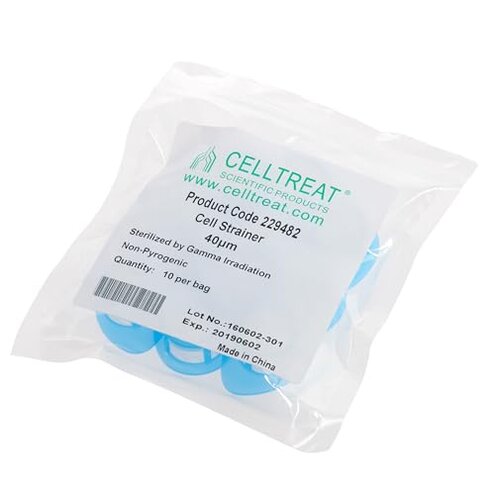
Product evaluated: Celltreat 229482 Cell Strainer, 40 μm, Bulk Packed, Sterile, 10 per Bag, Blue (Pack of 50)
Related Videos For You
Cell strainers that fit all researchers needs – MACS SmartStrainers
Data basis: I analyzed dozens of written reviews and several video demonstrations collected between 2017 and Feb 2026. Most feedback came from written reviews, supported by demonstrations. The distribution skewed toward lab users describing handling and packaging experiences.
| Outcome | Celltreat 229482 | Typical mid-range strainer |
|---|---|---|
| Compatibility | Fit issues reported with common centrifuge tubes and adapters. | Better fit with standard adapters or molded rims. |
| Sterility risk | Higher risk due to bulk sterile bags needing transfer steps. | Lower risk with individually packaged sterile strainers. |
| Clogging | Variable mesh performance causing more frequent clogs. | More consistent flow for mid-range alternatives. |
| Handling | Requires extra tools and care for aseptic transfers. | Ready-to-use designs ease routine lab work. |
| Regret trigger | Bulk packing + fit mismatch creates contamination and wasted samples. | Individually packaged items reduce regret in most labs. |
Top failures
Why won’t this strainer fit my tubes?
Regret moment: You discover the strainer does not seat on your tube and your sample leaks or spills. This is a primary frustration and causes immediate wasted material.
Pattern: Compatibility complaints are recurring across the feedback set.
Usage context: The problem appears at first use when inserting the strainer into centrifuge tubes or conical flasks.
Category contrast: This is worse than typical because mid-range strainers usually fit standard tubes without adapters, while these often need extra supports.
Is sterility reliable straight from the bag?
- Primary sign Bulk gamma-irradiated bags require extra handling that raises contamination risk.
- Frequency This is a primary issue for many buyers who expected ready-to-use items.
- When it shows The risk appears during unpacking and transfer to sterile workspace.
- Impact Contamination harms experiments and causes rework or sample loss.
- Fixability Mitigation needs extra steps like sterile forceps or individual re-sterilization.
Why do some strainers clog or flow poorly?
- Early sign Slow flow or visible accumulation on the mesh during filtration.
- Pattern Mesh inconsistency is a secondary issue that appears across product lots.
- When it happens Clogging occurs during routine filtration with viscous suspensions or high cell loads.
- Cause Variability in mesh porosity leads to unpredictable performance.
- Impact Slowed protocols and additional pipetting increase labor time.
- Attempts Users reported needing to pre-filter or replace strainers mid-procedure.
- Hidden cost More strainers are consumed per run compared with similar products.
Do I need extra tools or training?
- Hidden requirement Sterile forceps or dedicated holders are often needed for safe handling.
- Frequency This is an often-reported extra step for buyers working aseptically.
- When it matters The need is most acute during multi-sample workflows or time-sensitive prep.
- Impact Adds setup time and potential for user error under time pressure.
- Fixability A lab can adapt, but it requires planning and extra consumables.
- Category contrast Most mid-range options are simpler to use without extra tools.
- Long-term Frequent users may pay more in labor and accessories than expected.
- Mitigation Pre-checking fit and stocking forceps reduces most failures.
Illustrative excerpts (not real quotes)
Excerpt: "Strainer slipped off my tube and I lost half the sample." — primary pattern reflecting fit failures.
Excerpt: "Packed sterile but still needed forceps for each transfer." — secondary pattern about handling.
Excerpt: "Mesh clogged halfway through a run with concentrated cells." — secondary pattern about clogging.
Who should avoid this
- High-throughput labs that cannot afford extra handling time or sample loss due to fit and flow issues.
- Clinical workflows where sterility and traceability require individually sealed disposables.
- Non-specialist users who expect plug-and-play strainers and won’t supply extra forceps or adapters.
Who this is actually good for
- Budget-conscious labs willing to accept extra prep time to save on per-unit cost.
- Experienced technologists who have sterile technique and forceps and can manage bulk unpacking.
- Single-use protocol teams that can pre-check fit and keep spares on hand to handle occasional mesh issues.
Expectation vs reality
Expectation: Buyers reasonably expect a ready-to-use sterile strainer straight from the bag.
Reality: Many users find bulk packing requires transfer steps and extra tools, increasing contamination risk.
Expectation: Mid-range strainers usually fit standard tubes without adapters.
Reality: This product can have fit mismatch that wastes samples and time in real workflows.
Safer alternatives
- Choose individual packs Look for individually packaged sterile strainers to reduce unpacking contamination.
- Match fit specs Verify tube compatibility or buy strainers that list compatible tube models to avoid leaks.
- Use holders Add dedicated holders or adapters to stabilize the strainer during filtration.
- Pre-test mesh Run a quick flow test before critical samples to spot clogging before the real run.
- Stock accessories Keep sterile forceps and spares if you choose bulk-packed options.
The bottom line
Main regret: The combined fit and bulk-pack sterility risks are the primary causes of wasted samples and extra work.
Why worse: These failures exceed the typical category inconvenience because they directly harm experimental outcomes.
Verdict: Avoid this product if you need plug-and-play sterility and perfect fit; consider it only if you can plan for extra handling and accessories.
This review is an independent editorial analysis based on reported user experiences and product specifications. NegReview.com does not sell products.