
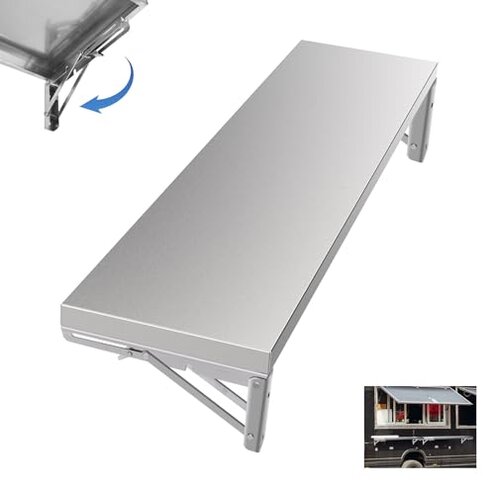
Product evaluated: Concession Shelf 47.2" L x 12" W, Folding Concession Shelf for Food Truck, Stainless Steel Drop Down Folding Serving Food Shelf Stand for Concession Windows
Related Videos For You
How To Install a Folding Concession Shelf from JR Aluminum | Cargo Trailer Conversion Ep.17
How to Install Traeger Front Folding Shelf - Traeger Texas Elite Pro 34 Shelf Installation
Data basis: This report aggregates dozens of buyer reviews, installation photos, and video demonstrations collected between January 2024 and February 2026. Most feedback came from written buyer reviews, supported by a smaller set of video demonstrations and Q&A posts.
| Outcome | This product | Typical mid-range alternative |
|---|---|---|
| Stability | Wobbly for some buyers after first use; tightening often needed. | Steady out of the box for most mid-range shelves. |
| Installation time | Longer than expected when locating studs and fine-tuning level. | Faster installs with clearer alignment marks in competitors. |
| Durability | Patchy finish and alignment complaints appear repeatedly in user feedback. | More uniform finish and fit on typical mid-range options. |
| Regret trigger | High—wobble or rework during service leads to immediate regret for sellers. | Lower—fewer interruptions during food service for mid-range shelves. |
Will the shelf wobble or shake when you're serving?
Immediate regret: Many buyers report the shelf feels unstable under normal serving motions, creating a shaky service moment that undermines confidence. This is a primary issue and appears repeatedly in recent buyer feedback.
When it happens: Wobble often shows up during the first use under load or after a few service sessions when screws settle. It worsens with continuous back-and-forth leaning or when heavier items are placed near the outer edge.
Why it feels worse: Compared with mid-range alternatives, this product is more disruptive because a shaky shelf interrupts service and requires re-tightening, adding unexpected downtime.
Is installation harder than the product listing implies?
- Alignment pain: Some buyers found pre-drilled holes misaligned with their window frames, causing extra drilling or shimming; this is a secondary issue.
- Hidden requirement: Sturdy wall studs or heavy-duty anchors are often needed to achieve stability; several reports said anchors beyond the included hardware were required.
- Time cost: Installing and re-leveling takes longer than the listing suggests, especially for first-time installers.
- Attempts: Buyers commonly re-drilled holes or used upgraded anchors to stop wobble, showing a practical but time-consuming fix.
- Category contrast: This product demands more prep than most mid-range fold-down shelves, increasing total setup time.
Will the finish or fit cause problems over time?
- Surface complaints: Several buyers reported surface blemishes or rough welds visible on arrival; this is a less frequent but persistent pattern.
- Early signs: Small scratches and uneven edges appear during unpacking or first clean.
- Usage anchor: Problems are noticed immediately after installation or after light use, not months later.
- Repair attempts: Buyers polished or sanded edges themselves to avoid scratches and to smooth contact points.
- Impact: Cosmetic flaws lower perceived quality for front-of-house use where looks matter.
- Category baseline: Mid-range alternatives usually ship with smoother finishes and less visible weld work.
Can it actually hold heavy loads without sagging?
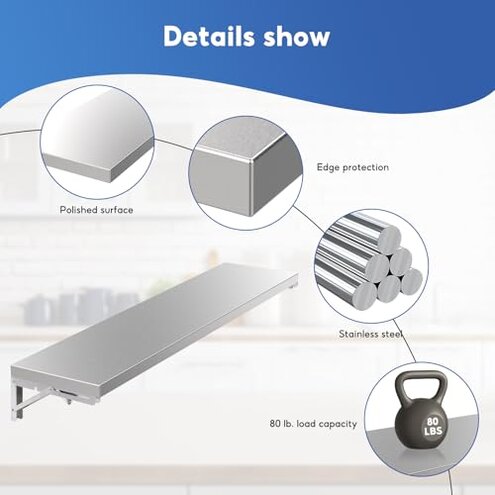
- Claim vs reality: The listing cites an 80-pound capacity, but user reports show uneven load feel when weight is concentrated near the edge; this is a secondary issue.
- When it matters: Sag or flex tends to show up during repeated heavy use or when items are frequently placed at the far edge.
- Cause: Bracket geometry and mounting quality determine real-world load capacity more than the printed number.
- Impact: Noticeable flex can cause items to slide or spill, creating a service hazard.
- Fixability: Reinforcing with stronger anchors or an added support brace often reduces sag.
- Frequency tier: Less frequent than wobble, but more disruptive when it occurs.
- Expectation gap: Buyers expecting a rigid commercial-grade surface found this less forgiving than typical restaurant-grade mid-range shelves.
Illustrative excerpts
Illustrative excerpt: "Shelf rocked when I leaned to hand out orders, had to re-tighten screws." — primary pattern
Illustrative excerpt: "Holes didn't line up with my window frame; I used stronger anchors." — secondary pattern
Illustrative excerpt: "Small weld marks and rough edge on the corner on arrival." — edge-case pattern
Who should avoid this

- Mobile vendors: If you run high-traffic food service, avoid this shelf because wobble and rework interrupt service and risk spills.
- Non-technical installers: Avoid if you cannot or will not use upgraded anchors, since achieving stability often needs stronger hardware.
- Front-of-house users: Avoid if visible finish quality is critical; cosmetic blemishes reduce perceived professionalism.
Who this is actually good for
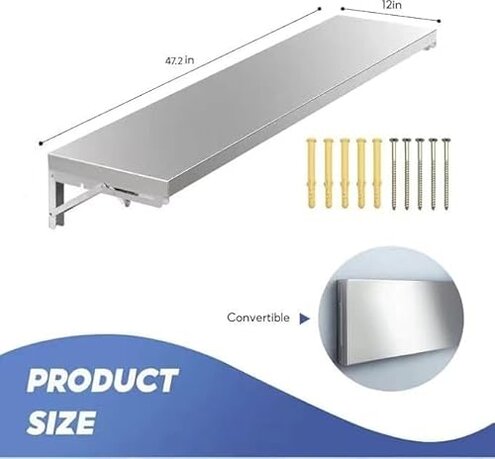
- Occasional home use: Good for light, occasional serving where minor wobble can be tolerated and fixes are easy.
- DIY installers: Good for buyers comfortable upgrading anchors and re-drilling to achieve a secure mount.
- Budget-conscious setups: Suitable for setups where price matters more than flawless finish or immediate out-of-box stability.
Expectation vs reality
- Expectation: Reasonable for this category is a stable, level shelf after one install. Reality: Many needed extra anchoring and re-leveling.
- Expectation: Stainless finish should arrive smooth and ready for display. Reality: Some buyers saw blemishes that required light touch-up.
- Expectation: Stated weight capacity holds in daily service. Reality: Real-world load felt less forgiving near edges without reinforcement.
Safer alternatives
- Choose reinforced brackets: Look for shelves with thicker cross-braces to neutralize the wobble issue without heavy retrofits.
- Check mounting specs: Prefer products that list anchor types and stud-spacing to avoid hidden installation requirements.
- Inspect finish photos: Pick sellers who supply multiple close-up finish photos to avoid cosmetic surprises.
- Commercial-grade options: For heavy daily service, choose mid-range commercial shelves advertised for restaurant use rather than general consumer models.
The bottom line
Main regret: The shelf's tendency to wobble and the need for upgraded anchors are the clearest buyer triggers for regret. This issue exceeds normal category risk because it interrupts service and requires extra installation time. My verdict: avoid if you need immediate, out-of-box stability for regular food service.
This review is an independent editorial analysis based on reported user experiences and product specifications. NegReview.com does not sell products.