
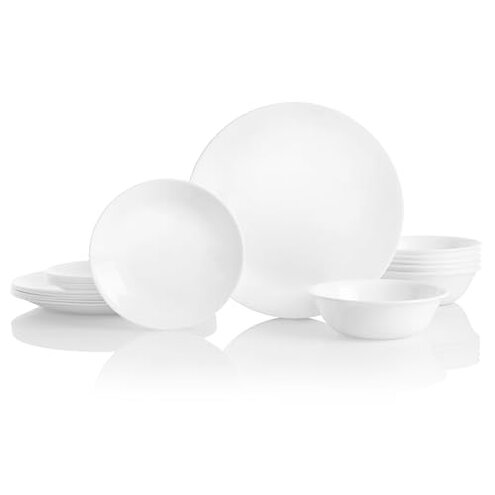
Product evaluated: Corelle Vitrelle 18-Piece Service for 6 Dinnerware Set Triple Layer Glass and Chip Resistant, Lightweight Round Plates and Bowls Set, Winter Frost White
Related Videos For You
URGENT! Warning! Why PYREX dishes shatter! #shorts
【Glass dinnerware set】Top 4 Glass Dinnerware Sets you need in your kitchen
Data basis This report summarizes hundreds of buyer comments collected from written feedback and video-style demonstrations between 2024 and 2026. Most feedback appears to come from written experiences, with supporting visual examples that help show breakage, daily handling, and long-term use patterns.
| Buyer outcome | This set | Typical mid-range alternative |
|---|---|---|
| Daily handling | Lighter and easier to carry, but less forgiving if mishandled during temperature changes | Heavier, but usually less sensitive to everyday hot-to-cold mistakes |
| Break behavior | Can shatter dramatically when stress happens, which feels more disruptive than expected | More often chips or cracks before total failure |
| Upkeep burden | Needs caution with hot items, wet surfaces, and cold cloths | Lower handling sensitivity in normal kitchen use |
| Replacement risk | Higher-than-normal category risk if your household is fast-paced or rough on dishes | More predictable wear pattern for casual family use |
| Regret trigger | Unexpected breakage after a routine kitchen moment | Visible wear that is annoying but usually less sudden |
Do you want dishes that feel sturdy without surprise shattering?
This is the primary issue. The main regret moment is not normal wear. It is a plate or bowl seeming fine, then breaking more dramatically than buyers expect during ordinary meal cleanup or reheating.
The pattern appears repeatedly. It is not universal, but it is among the most disruptive complaints because failure can be sudden and messy instead of gradual.
When it shows up is often during daily use, especially after heating food, moving a hot piece, or setting it onto a cooler or damp surface.
Category contrast matters here. Dinnerware can always break, but this feels worse than a typical mid-range set because buyers often expect a chip-resistant product to fail less dramatically.
Illustrative excerpt: “Fine for months, then one bowl exploded during normal cleanup.” Primary pattern
Are you okay with hidden handling rules in everyday meals?
- Hidden requirement: The set needs extra care around sudden temperature changes, including hot food, wet counters, and cold cloths.
- Frequency tier: This is a primary issue because the care limits affect regular kitchen routines, not rare edge conditions.
- Usage moment: Trouble tends to appear after reheating or right after serving, when people naturally move dishes quickly.
- Why it frustrates: The added caution creates extra steps in a product many buyers want for easy everyday use.
- Common attempt: Buyers often try treating it like normal dishware, which is exactly when the product can feel less forgiving than expected.
- Fixability: The only real fix is behavior change, not a setting or accessory.
- Category contrast: Most mid-range alternatives still require care, but this set can demand more attention during routine hot-to-cold transitions.
Illustrative excerpt: “I did not expect plates to need this much temperature caution.” Primary pattern
Do you need dinnerware for a busy family kitchen?
- Secondary issue: The set is lightweight, which many people like, but that same feel can read as less reassuring in crowded kitchens.
- When it worsens: The concern grows during fast cleanup, frequent reheating, or homes with kids and constant dish rotation.
- Impact: Buyers may start handling pieces more carefully than they planned, which reduces the convenience benefit.
- Early sign: Regret often starts when owners realize they are changing habits to avoid accidents.
- Pattern signal: This appears repeatedly, though it is less frequent than breakage complaints themselves.
- Why worse than normal: Lightweight dinnerware is common, but here the light feel combined with heat-shock caution can make it seem less robust than mid-range expectations.
Illustrative excerpt: “They are easy to lift, but I stopped trusting them in rush-hour cleanup.” Secondary pattern
Will plain white stay satisfying once you start replacing pieces?
- Secondary pattern: A plain white set is easy to match, but it can also make replacement feel more noticeable when one piece fails.
- Usage context: This frustration shows up after months of use, when a once-complete set no longer feels complete.
- Buyer impact: The product is sold as an 18-piece set for service for 6, so losing even one part can reduce the tidy matching appeal.
- Effort cost: Replacing individual pieces adds extra shopping time and can turn a low-fuss set into a maintenance task.
- Pattern strength: This is not the most common complaint, but it is more frustrating when it follows sudden breakage.
- Category contrast: Any dinnerware set can lose pieces, but simple white sets often get chosen for long easy ownership, so replacement friction feels more disappointing.
- Fixability: This is partly fixable if you are willing to buy extras early.
Illustrative excerpt: “One broken bowl made the whole set feel incomplete.” Secondary pattern
Illustrative excerpt: “Great until a hot plate touched water and broke apart.” Edge-case pattern
Who should avoid this
- Avoid it if your kitchen routine is rushed and dishes often move from microwave to sink in one step.
- Avoid it if you want dinnerware that is more forgiving than average during hot-to-cold handling mistakes.
- Avoid it if kids, roommates, or frequent guests make careful handling unrealistic every day.
- Avoid it if sudden break behavior would bother you more than slow chipping or cosmetic wear.
Who this is actually good for
- Good fit for careful households that value low weight and are willing to follow the temperature-handling limits.
- Good fit for people who want a plain white set and do not mind treating it more gently than typical everyday dishes.
- Good fit for smaller homes where dishes are used calmly, not in a high-speed family cleanup cycle.
- Good fit for buyers who accept the hidden requirement of dry, gradual handling in exchange for easier carrying.
Expectation vs reality
Expectation: Chip-resistant dinnerware should be reasonably forgiving for normal reheating and cleanup.
Reality: The bigger complaint is not chipping. It is heat-shock sensitivity during everyday kitchen transitions.
Expectation: Lightweight plates should make daily use easier.
Reality: They do feel easy to handle, but some buyers end up handling them more carefully, which offsets the convenience.
Expectation: A basic white set should be simple to own for years.
Reality: If a piece fails suddenly, the replacement hassle can become the real annoyance.
Safer alternatives
- Choose heavier options if you want dishes that are less sensitive to routine hot-to-cold mistakes.
- Pick sets known for gradual wear if you would rather see chips first than risk sudden dramatic breakage.
- Look for microwave-to-sink tolerance if your usual habit is reheating and rinsing right away.
- Buy open-stock availability if keeping a matching set matters after years of normal losses.
The bottom line
Main regret trigger is sudden breakage tied to temperature-change sensitivity during normal kitchen moments. That exceeds normal category risk because buyers expect chip-resistant dinnerware to be easier, not more demanding, in daily handling. Verdict: avoid this set if your household treats dishes like true everyday workhorses rather than careful-use tableware.
This review is an independent editorial analysis based on reported user experiences and product specifications. NegReview.com does not sell products.