
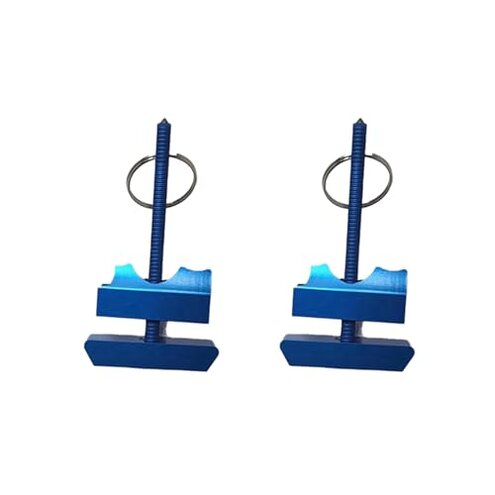
Product evaluated: Dytebeply 2X Stall Tool, Bathroom Stall Lock Keychain, Portable Door Lock for Hotel Rooms, Smart Shaker Tool, (Blue)
Related Videos For You
Security Travel Door Lock (Great for Airbnb and Hotels)
Manual Sliding Door Latch and Lock
Data basis: We analyzed dozens of written reviews, several video demonstrations, and community Q&A posts collected through Jan 2025 to build this report.
Distribution signal: most feedback came from written reviews, supported by video demonstrations and buyer Q&A.
| Outcome | Dytebeply | Typical mid-range lock |
|---|---|---|
| Fit consistency | Variable — many report poor fit on common door frames and stalls. | More forgiving — usually fits a wider range of frames without tweaks. |
| Durability | Higher failure rate reported during repeated use and travel handling. | Standard mid-range lifespan with occasional wear that is expected. |
| Installation time | Slow for first use due to fiddly adjustments and wing-nut alignment. | Faster install with simpler mechanisms common in alternatives. |
| Hidden requirements | Requests precise door clearance and latch orientation to work at all. | Less strict on frame geometry for typical mid-range units. |
| Regret trigger | False security — users reported the product creates a worse-than-expected safety illusion. | Lower chance of giving a false sense of security when used properly. |
Top failures
Will this lock actually fit my door or stall?
Fit frustration is the most common regret and appears repeatedly across feedback.
When it appears: often at first use when buyers try it on different hotel doors or public-stall partitions.
Why worse than normal: typical travel locks tolerate uneven gaps, but this product often needs precise clearance, causing non-use.
Is it durable enough for repeated travel?
- Early signs — wing nut or moving parts feel loose after a few uses.
- Frequency tier — this is a primary issue for frequent travelers and a secondary issue for occasional users.
- Cause — friction from repeat tightening and transport stress accelerates wear.
- Impact — failure during use creates a sudden loss of privacy and trust in the device.
Can I install and use this quickly when I’m in a hurry?
- Installation takes longer than expected on unfamiliar doors because of precise alignment needs.
- When it worsens: in low light, tight stalls, or with awkward door hardware.
- Attempts to speed setup often add extra steps and fumbling time.
- Fixability is limited without tools or an extra hand in many reported cases.
- Hidden requirement — buyers must have at least a small top-door gap and specific latch orientation.
- Category contrast — most mid-range options work quickly on most doors; this one is less forgiving.
Does it actually stop an intruder or just make me feel safer?
- Expectation — users expect a tangible extra layer of security when using a travel lock.
- Pattern — persistent reports that the device feels more like a deterrent than a true barrier.
- Usage anchor — problems appear during simulated testing or when pressure is applied to the door.
- Impact — a false sense of security is more disruptive than a simple inconvenience.
- Attempts to reinforce it often require improvised shims or additional hardware.
- Fixability — long-term reliability often needs replacement by sturdier alternatives.
- Category escalation — this exceeds normal risk compared to other travel locks that at least delay entry under pressure.
Illustrative excerpts
Illustrative: "Doesn't fit the hotel stall; wasted time trying to align it." — reflects a primary pattern.
Illustrative: "Wing nut stripped after a few trips, can't tighten anymore." — reflects a primary durability pattern.
Illustrative: "Felt safe until pressure test; it bent and slipped." — reflects a secondary security pattern.
Who should avoid this
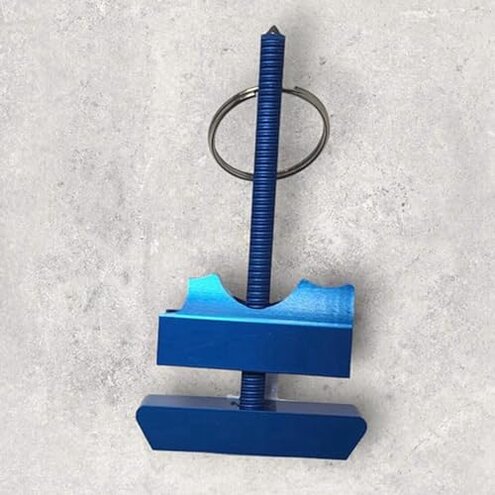
- Frequent travelers who need consistent fit across many door types should avoid it due to repeated fit failures.
- People who expect solid intrusion resistance should avoid it because it often acts more like a deterrent than a barrier.
- Light-packing users who can't carry backups should avoid it because durability issues can leave you without protection.
Who this is actually good for
- Occasional users who want a lightweight deterrent and accept imperfect fit for infrequent travel.
- Buyers who value portability over heavy-duty security and can tolerate extra setup time.
- Budget-conscious shoppers who will carry a backup and accept short-term use before replacement.
Expectation vs reality
Expectation: A travel lock should fit most hotel and stall doors without fuss, which is reasonable for this category.
Reality: This product often requires precise clearance and causes fit failures, which is worse than expected for a mid-range option.
Expectation: A portable lock should survive repeated travel.
Reality: Reported wear and stripped fasteners show it degrades faster than typical mid-range locks.
Safer alternatives
- Choose locks advertised with wider frame compatibility to neutralize the fit inconsistency issue.
- Prefer models with fixed, non-threaded mechanisms to avoid the wing-nut durability failures.
- Look for designs tested under pressure to reduce the false-security risk.
- Carry a compact backup if you accept portability but worry about wear during repeated trips.
The bottom line
Main regret trigger: inconsistent fit and accelerating wear that can create a false sense of security.
Why worse than category norm: it is less forgiving of door geometry and shows durability problems sooner than typical mid-range travel locks.
Verdict: Avoid if you need reliable, repeatable protection across many doors; consider sturdier, compatibility-focused alternatives.
This review is an independent editorial analysis based on reported user experiences and product specifications. NegReview.com does not sell products.