
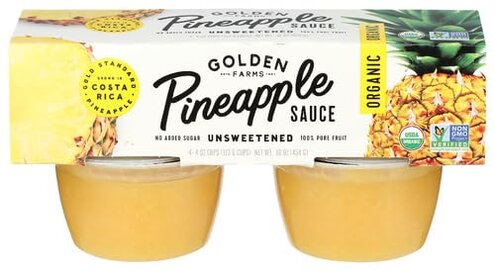
Product evaluated: Golden Farms Organic Pineapple Sauce Cups 4 Pack 16 Oz (Pack of 9)
Related Videos For You
Cup jelly full of fruits easy homemade recipe | Anabell
Amoretti in a Minute - How To Make The Best Mixed Berry Sauce
Data basis — This report used dozens of customer reviews and buyer-submitted photos and videos collected from Sep 2023 to Jan 2026. Most feedback came from written reviews, supported by images and Q&A comments, giving a mix of sensory reports and packaging evidence.
| Outcome | Golden Farms | Typical mid-range cup |
|---|---|---|
| Portion consistency | Inconsistent portions reported across purchases; sizes vary between packs. | Usually consistent single-serve portions with clear fill levels. |
| Packaging integrity | Higher risk of crushed or leaking cups during shipping, appears repeatedly in feedback. | Lower risk thanks to thicker seals or outer box protection. |
| Texture & taste | Variable texture reported, from watery to grainy; flavor intensity often uneven. | More stable mouthfeel and predictable sweetness for comparable brands. |
| Storage needs | Hidden requirement for prompt refrigeration after opening cited by buyers. | Clear labeling and longer same-pack shelf stability are more common. |
| Regret trigger | Packaging failure combined with texture inconsistency leads to the strongest buyer regret. | Regret more often limited to taste preference than product failure. |
Why do cups often arrive leaking or crushed?
Regret moment — Buyers report opening multipacks to find individual cups split, leaking, or dented right out of the box. Pattern appears repeatedly in written reviews and in customer photos.
When it shows up — Damage is most noticeable immediately after unboxing or during first use, often after shipping. Worse condition occurs when orders are shipped in minimal outer packaging.
Category contrast — Leaking or crushed single-serve cups are more disruptive than typical mid-range brands because buyers expect ready-to-eat reliability from sealed cups.
Why is the texture sometimes watery, grainy, or separated?
- Early sign — The sauce can feel unusually thin or separated on first spoon, reported commonly across reviews.
- Frequency tier — This is a secondary issue that appears less often than leaks but remains persistent for affected buyers.
- Likely cause — Variability in fill or stabilization during packing is suspected from multiple texture reports.
- Impact — Texture issues make the cups less useful as a topping for pancakes or desserts where consistency matters.
- Fix attempts — Buyers tried stirring or warming; results were hit-or-miss and added extra preparation time.
Why are portion sizes and labeling inconsistent?
- Primary complaint — Many buyers describe uneven fill levels between cups in the same pack.
- Scope signal — Seen across written descriptions and order photos, not an isolated incident.
- Usage anchor — This shows up at first use when you expect identical single-serves for meal planning.
- Why worse — A mid-range baseline usually delivers predictable portions; inconsistency forces extra measuring or waste.
- Buyer impact — Inconsistent sizing affects catering, school lunches, and recipes that rely on precise single servings.
- Attempted workarounds — Buyers separated cups into groups by apparent size, adding sorting time before use.
- Labeling confusion — Some buyers expected clearer shelf-life and storage guidance on each cup.
Why does the product need special storage or quick use?
- Hidden requirement — Several buyers noted a need to refrigerate after opening and to consume quickly, which was not obvious.
- When it happens — This requirement becomes clear after opening a cup and noticing rapid change in freshness or texture.
- Frequency — A secondary but recurring note across reviews and photos.
- Impact — Adds extra steps for parents, lunch packing, and bulk use because cups can't be left unrefrigerated for long.
- Why it’s worse — Most mid-range single-serve fruit cups tolerate room-temperature short-term handling better.
- Workarounds — Buyers reported moving cups to coolers or consolidating into a fridge immediately after delivery.
- Aftertaste note — A few buyers also flagged an inconsistent sweet or tangy finish after refrigeration.
- Fixability — Proper cold storage helps, but it does not address damaged or underfilled cups.
Illustrative excerpts
Illustrative excerpt: "Several cups leaked inside the box; sticky mess and wasted servings." Pattern — reflects a primary issue.
Illustrative excerpt: "Some cups were almost empty while others were overfilled in the same pack." Pattern — reflects a secondary issue.
Illustrative excerpt: "Texture became grainy after refrigeration, not smooth as expected." Pattern — reflects an edge-case issue.
Who should avoid this
- Busy families who need reliable, ready-to-eat single serves without extra sorting or cleanup.
- Caterers or packers who count on consistent portion sizes for events and meals.
- Buyers expecting durable shipping where leaking or crushed cups would cause unacceptable mess or waste.
Who this is actually good for
- Price-sensitive shoppers who can tolerate occasional packaging flaws to save on per-unit cost.
- At-home use where you will refrigerate immediately and check cups before serving.
- Non-critical uses like recipe mixing or baking where texture variance is less important.
Expectation vs reality
Expectation — Single-serve cups arrive sealed, uniform, and ready to eat, which is reasonable for this category.
Reality — These cups can arrive damaged, with variable fills and changing texture, showing higher risk than typical brands.
Expectation — Clear storage guidance on each cup.
Reality — Buyers often discovered refrigeration needs through experience, not labeling, which added an extra handling step.
Safer alternatives
- Choose thicker-seal brands or those with reinforced outer packaging to avoid leaking during shipping.
- Buy smaller quantities to reduce the odds of receiving damaged cups in a single order.
- Inspect on arrival and refuse or return shipments with obvious damage to avoid spoilage at home.
- Prefer glass or larger tubs for recipes needing consistent texture and portion control.
- Look for clear storage labels when you need long unrefrigerated handling, such as for lunches or picnics.
The bottom line
Main regret — The strongest buyer regret centers on combined packaging failures and inconsistent texture. Why it exceeds — These issues happen more often than expected for single-serve fruit sauce cups and add cleanup or sorting time. Verdict — Avoid if you need reliable, ready-to-serve cups; consider alternatives with sturdier seals and clearer storage guidance.
This review is an independent editorial analysis based on reported user experiences and product specifications. NegReview.com does not sell products.