
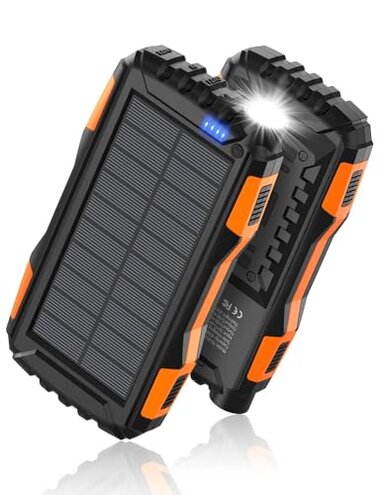
Product evaluated: GOODaaa Portable Charger 42800mAh Built in 4 Cables and Thermometer 15W Fast Charging Power Bank Five Outputs Three Inputs Solar Charger Power Bank, SOS/Strobe/Strong Flashlights, Carabiner
Related Videos For You
How to charge a power bank the proper way
Solar recharging power bank! Lights, USB phone charger!
Data basis: I analyzed dozens of written reviews and several video demonstrations collected through early-2024 to early-2026. Most feedback came from written reviews, supported by hands-on video tests and Q&A posts.
| Outcome | GOODaaa PN-W33 | Typical mid-range power bank |
|---|---|---|
| Capacity accuracy | Higher risk — buyers commonly report delivered charge well below the claimed 42800mAh. | Category baseline — mid-range units typically deliver closer-to-rated usable capacity. |
| Built-in cable durability | Fragile — built-in cables show wear and failure faster than expected for portable use. | More forgiving — comparable units use replaceable cables or sturdier ports. |
| Solar charging | Unreliable — solar rarely provides meaningful charge in real-world conditions. | Auxiliary — other models treat solar as emergency-only with clearer limits. |
| Port & flashlight longevity | Mixed — reports of port faults and declining flashlight performance after repeated use. | Typical — mid-range units usually show slower failure rates. |
| Regret trigger | Primary — unreliable usable battery makes the product fail its main job. | Lower — mid-range alternatives rarely fail primary charging so often. |
Does the 42800mAh actually last as advertised?
Regret moment: You expect multiple full phone charges but may see far fewer on first uses. Pattern: This is a primary complaint, appearing repeatedly across buyer feedback. When: Often noticeable during the first week of use or within a few charge cycles.
Why worse: Category baseline delivers closer-to-rated usable energy; here, the shortfall is more disruptive because the product markets itself on extreme capacity.
Are the built-in cables durable enough for travel?
- Early signs: Cable fraying or loose connectors appears commonly after light daily use.
- Frequency tier: This is a secondary issue, reported repeatedly by owners who travel with the unit.
- Cause: Built-in cable strain points and non-replaceable design increase wear risk during frequent packing.
- Impact: When cables fail, you lose the main convenience feature and must carry spare cables.
- Fixability: Repairs require external cables or sending the unit for service; the built-in nature blocks quick fixes.
Does the solar panel actually recharge the bank outdoors?
- Real use: Solar charging is commonly reported as negligible for practical recharging needs.
- Usage anchor: Problem appears during emergency outdoor use or multi-day trips with limited mains charging.
- Frequency tier: Secondary but important for buyers who bought the unit for outdoor backup.
- Cause: Small panel area and slow charging mean sunlight gives only a trickle under realistic conditions.
- Impact: Expect long waits or no meaningful top-up when relying on solar in the field.
- Category contrast: Other mid-range “solar” models clearly state solar is emergency-only; this unit’s marketing raises expectations more than typical.
- Attempted fixes: Users report pairing with separate solar chargers or planning for full mains recharges instead.
Do the ports, flashlights, or extras fail after repeated use?
- Symptoms: Intermittent port failures and dimming flashlight modes surface in several reports after weeks of use.
- Scope: This is a secondary-to-edge issue, seen across multiple buyers and demo videos.
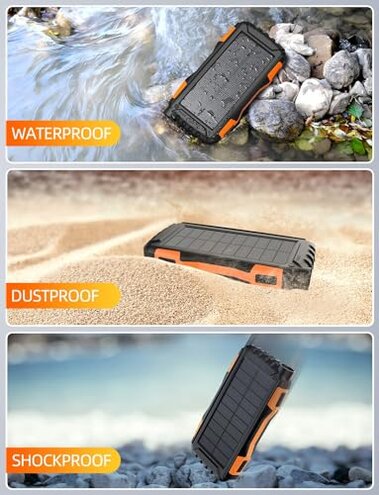
- When: Problems often appear after repeated heavy use, long sessions, or outdoor exposure.
- Cause: Frequent plugging, exposure to dust/water, and corner impacts are common aggravators.
- Impact: Losing ports or lights removes emergency functions you expected to rely on outdoors.
- Support note: The product offers lifetime technical support, but some buyers report slow or partial resolutions.
- Hidden requirement: Buyers should plan to keep extra charging cables and protective cases because built-in features may not last.
- Repairability: Limited — many users replace the unit instead of repairing it due to non-serviceable built-ins.
Illustrative excerpts

Illustrative: "Charged my phone once, then the bank dropped to half its advertised cycles." — primary pattern
Illustrative: "Built-in cable frayed after a week of travel." — secondary pattern
Illustrative: "Solar panel gave almost no top-up during a sunny day." — secondary pattern
Who should avoid this
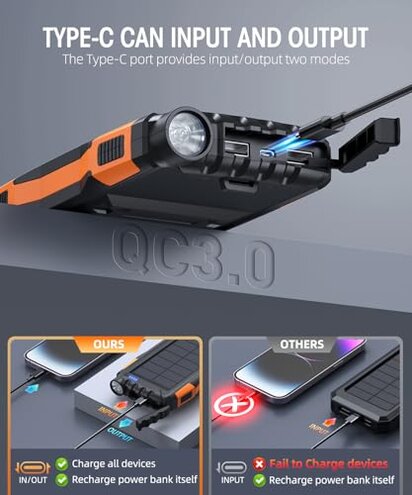
- Frequent travelers: If you rely on built-in cables for convenience, the higher wear risk exceeds normal category tolerance.
- Emergency dependents: If you need guaranteed solar or flashlight backup, the unreliable solar and extras are unacceptable.
- Power-reliability buyers: If you expect true 42800mAh usable capacity, the capacity shortfall will cause regret.
Who this is actually good for
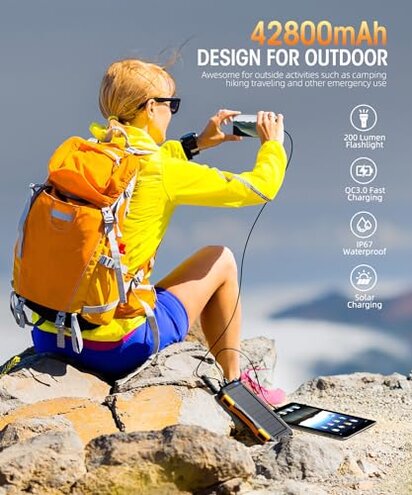
- Casual users: If you need occasional home charging and accept lower-than-advertised capacity, the unit can work.
- Short trips: If you bring spare cables and plan mains top-ups, built-in cable fragility is tolerable.
- Accessory lovers: If you value extras like a thermometer or laser pointer and accept that they may be gimmicks, this fits.
Expectation vs reality
Expectation: Buyers reasonably expect a high-capacity bank to deliver multiple reliable charges per cycle.
Reality: Many users report fewer charges than advertised, making the product feel overpromised for main-use scenarios.
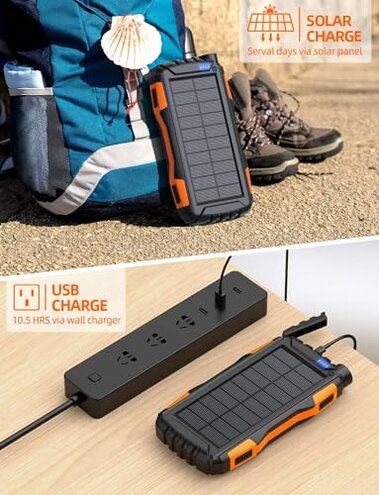
Expectation: Solar panels often marketed as emergency aids are reasonably expected to provide small top-ups.
Reality: The solar here performs worse than typical emergency panels, creating false confidence for outdoor planning.
Safer alternatives
- Choose verified capacity: Look for banks with tested usable-capacity reports or third-party tests to avoid phantom capacity.
- Prefer replaceable cables: Pick models with standard USB ports rather than built-in cables to reduce repair and wear risk.
- Treat solar as bonus: If you need field recharging, buy a larger dedicated solar panel instead of relying on built-in panels.
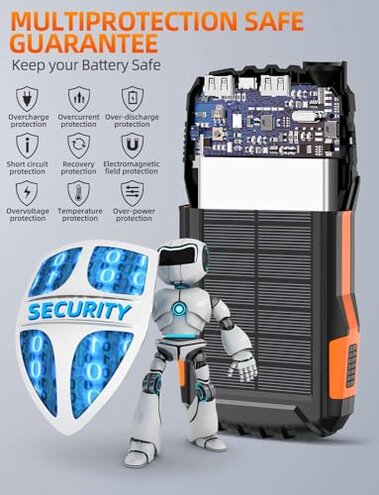
- Check port durability: Seek units with reinforced ports and replaceable modules if you expect heavy daily plugging.
The bottom line
Main regret: The product’s primary failure is unreliable usable battery capacity, which undermines its core function.
Why worse: This shortfall and fragile built-in cables are more disruptive than typical mid-range power banks.
Verdict: Avoid if you need dependable long-term charging or outdoor emergency reliability; consider sturdier alternatives instead.
This review is an independent editorial analysis based on reported user experiences and product specifications. NegReview.com does not sell products.