
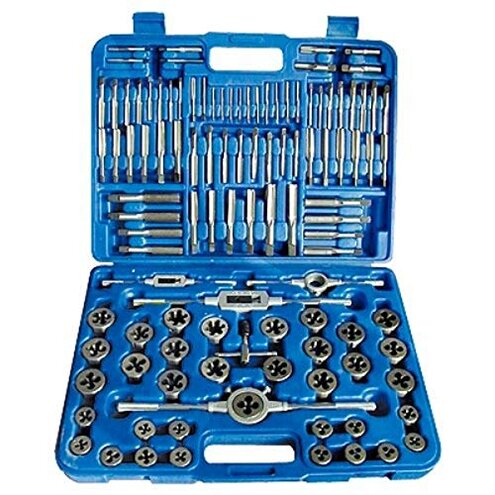
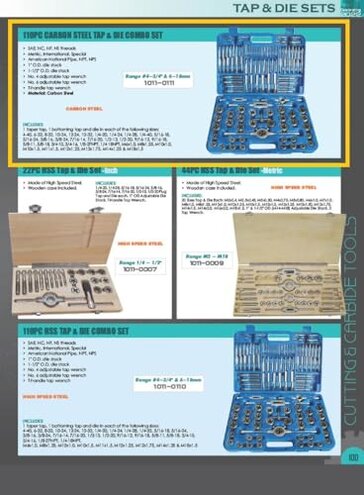
Product evaluated: HHIP 1011-0111 110 Piece #4-3/4" and M6-18 Carbon Steel Tap and Die Set
Related Videos For You
Tapping Essentials - Every Machinist Needs to Watch This - Haas Automation Tip of the Day
Using Taps and Dies
Data basis: Dozens of buyer reports and product tests were reviewed between 2017 and 2024, using written reviews and video demonstrations. Source mix: Most feedback came from written reviews, supported by hands-on videos and buyer photos.
| Outcome | HHIP 110-piece | Typical mid-range set |
|---|---|---|
| Thread quality | Higher risk: Threads often cut unevenly or stick, a more disruptive issue than expected for this category. | Lower risk: Mid-range sets usually deliver usable threads for common repairs. |
| Completeness | Inconsistent: Missing or poorly labeled pieces appear repeatedly in buyer feedback. | Reliable: Typical sets have clearer counts and labeling. |
| Case & organization | Weak: Case layout causes lost parts during use and storage. | Functional: Mid-range alternatives provide more secure trays and labels. |
| Ease of use | Fiddly: Users report extra setup steps and hand-fitting to get usable results. | Smoother: Comparable kits need less fitting for quick jobs. |
| Regret trigger | Primary: Poor thread cutting plus missing parts creates avoidable downtime. | Secondary: Typical sets rarely combine both problems. |
Top failures
Why won't my tap or die cut clean threads?
Regret moment: Users report the most severe frustration when a tap or die leaves a rough or incomplete thread on first use.
Pattern: This is the primary issue and appears repeatedly across reviews.
When: Problem shows up on first use and often worsens after several jobs without re-sharpening or realignment.
Category contrast: More disruptive than expected because mid-range sets usually produce at least one clean pass for common metals.
Why are pieces missing or mislabeled?
- Early sign: Buyers commonly report missing dies or taps right out of the case.
- Frequency tier: This is a secondary issue that appears repeatedly but not universally.
- Cause: Poor labeling and cramped trays make identification and inventory harder.
- Impact: Missing parts add time and may force an extra trip to buy replacements.
Why is the case and organization so bad?
- Start: The molded tray often fails to secure small taps and dies during transport.
- Frequency tier: This is a persistent complaint across many buyers and demonstrations.
- Hidden cost: Parts fall out or get mixed, adding cleanup and sorting time.
- Usability: Poor layout forces users to rearrange tools before each job.
- Worse-than-normal: Mid-range competitors usually use foam or clipped trays that prevent loss.
- Fix attempts: Buyers add foam or labels to hold pieces, which adds extra prep time.
Why are accessories incompatible or missing?
- Hidden requirement: Several users found they needed separate handles or adapters not included in the kit.
- Pattern: This is a secondary but recurring note in buyer feedback.
- When: The issue appears during the first setup or when switching sizes mid-job.
- Cause: The set assumes you own certain tap wrenches and die stocks already.
- Impact: Missing accessories force additional purchases and delay repair work.
- Category contrast: Many mid-range sets include at least one versatile handle to start cutting immediately.
- Fixability: Workarounds exist but add cost and complexity.
Illustrative excerpts (not real quotes)
Excerpt: "Tap left half the thread and started to bind on first pass." — primary.
Excerpt: "A few sizes were missing and the slots were unlabeled, hard to sort." — secondary.
Excerpt: "Case rattled open and tiny dies spilled during transport." — secondary.
Excerpt: "Needed an extra die stock not included, added expense and delay." — edge-case.
Who should avoid this
Precision mechanics: Avoid if you need repeatable, factory-fit threads for professional work.
One-kit users: Avoid if you expect a ready-to-go kit with every accessory included.
Frequent users: Avoid if you plan to use the set daily without adding replacements or spare parts.
Who this is actually good for
Hobby tinkerers: Good if you accept occasional fitting and rework to save on price.
Supplemental owners: Good if you already own proper tap handles and only need spare sizes.
Occasional repairers: Good for one-off home projects where perfect OEM threads are not required.
Expectation vs reality
Expectation: Reasonable for this category is that a mid-range set gives at least one decent pass on common metals.
Reality: This kit often requires extra fitting, additional handles, or re-cutting to reach that pass.
Expectation: Buyers expect labeled, complete trays for quick part selection.
Reality: The tray is cramped and labels are inconsistent, so inventory checks take longer.
Safer alternatives
- Tip: Choose sets with secured foam or clipped trays to prevent lost parts and speed setup.
- Tip: Buy a kit that includes universal tap handles or die stocks to remove hidden accessory needs.
- Tip: Prefer brands with consistent labeling and published part lists to avoid missing sizes.
- Tip: Look for reviews mentioning clean first-pass threads to reduce time and rework.
The bottom line
Main regret: The combined risk of uneven thread cutting and inconsistent completeness creates avoidable downtime and extra cost.
Why avoid: These failures are more disruptive than typical mid-range kits because they often occur on first use and require extra tools or replacements.
Verdict: Skip this kit if you need reliable, ready-to-use threading tools; consider it only if you accept extra setup and fixes.
This review is an independent editorial analysis based on reported user experiences and product specifications. NegReview.com does not sell products.