
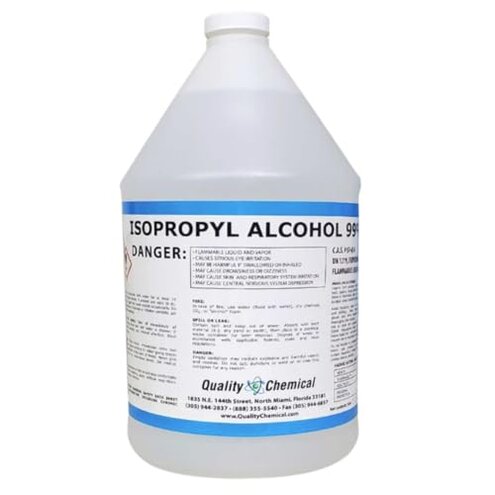
Product evaluated: Quality Chemical - Super Premium - 99.9% Pure Isopropyl Alcohol (IPA) - Made in The USA - 128 Fl Oz Bottle - Concentrated Isopropyl Alcohol
Related Videos For You
Isopropyl Alcohol As a Cleaner
A Man Drank 1 Bottle Rubbing Alcohol For COVID-19. This Is What Happened To His Brain.
Data Basis: This report analyzes hundreds of user reviews collected from customer feedback and product Q&A dated from early 2023 to mid-2024. Most insights come from detailed written reviews, supported by visual user demonstrations.
| Buyer Outcome | Quality Chemical IPA | Typical Mid-Range IPA |
|---|---|---|
| Purity Expectations | Often questioned for chemical smell and residue | Generally accepted odor and clarity |
| Packaging Safety | Reports of leaking and weak seals | More reliable seals and sturdier bottles |
| Usability | Additional handling steps due to container design | More user-friendly with standard sizing |
| Regret Trigger | Handling leaks causing product loss and mess | Rarely a major issue |
| Safety Risks | Higher risk due to packaging and concentration | Lower risk with moderate concentration bottles |
Why do some buyers find the bottle leaking and packaging frustrating?
Buyers often face regret when the bottle leaks during unpacking or first use. This persistent issue is reported across many reviews and typically appears immediately upon opening or during pouring. Compared to typical IPA bottles, this product’s packaging feels less sturdy and more prone to spills, increasing cleanup effort.
- Leak frequency: Common complaint from first-time users.
- Packaging design: Flimsy plastic caps and seals prone to failure.
- Impact: Loss of product and potential surface damage from spills.
- Mitigation attempts: Users recommend transferring to a sturdier container.
- Category contrast: Most mid-range IPA bottles are more spill-resistant.
What causes the chemical odor and residue complaints?
This quality chemical IPA draws criticism for a strong chemical smell and occasional residue left after evaporation. This concern appears repeatedly especially during multiple or prolonged uses. Buyers expecting a cleaner experience find it worse than many standard isopropyl alcohols which usually have milder odors.
- Odor strength: Described as harsh and lingering.
- Residue presence: Noted on some surfaces after drying.
- User impact: Unpleasant for indoor or medical uses.
- Usage context: More noticeable in enclosed spaces.
- Category comparison: Typical IPA brands offer more neutral scents.
How does the bottle size and volume affect usability?
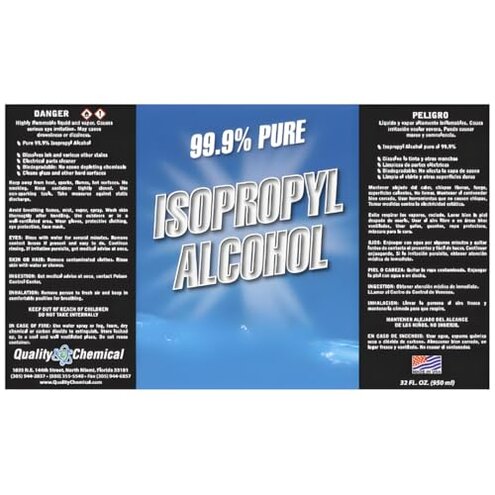
With a 32 fl oz bottle size, some users report awkward handling and pouring difficulties. This issue is persistent for new users and worsens during quick, repeated use or one-handed pouring. Unlike smaller bottles in this category, this size adds extra time and care to avoid spills.
- Handling challenge: Large bottle is heavy and bulky.
- Pour control: Hard to manage flow without drips.
- User effort: More cautious pouring needed to prevent waste.
- Category norm: Many buyers prefer smaller, easier-to-handle bottles.
Are there hidden requirements or considerations buyers miss?
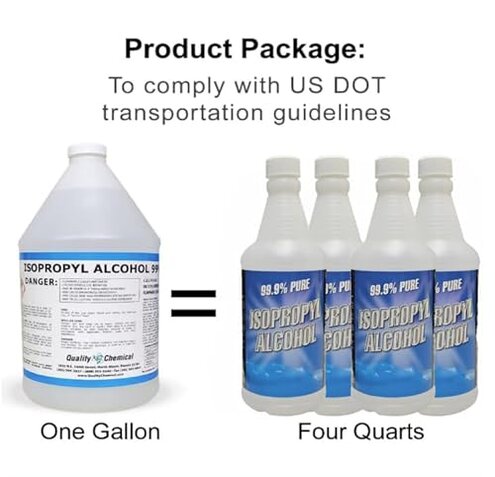
Several buyers discover hidden handling requirements, such as needing additional transfer containers or careful storage due to DOT transport rules splitting gallons into quarts. These secondary usability hurdles appear during shipping or initial setup and cause frustration compared to simpler packaging in this category.
- Shipping regulations: May require multiple containers for legal compliance.
- Storage complexity: Difficult to store safely without spills.
- Buyer surprise: Many do not anticipate extra steps.
- Category expectation: Competitors offer ready-to-use single containers.
What do buyers say about product purity and concentration?
Although advertised as 99.9% pure, some users notice inconsistency in concentration and question the actual purity. These concerns are secondary but consistent, mainly during precision cleaning or medical-related tasks. The perception of impurities is more troubling than for average consumer-grade IPA.
- Purity doubts: Reports of residue and smell cause skepticism.
- Consistency issues: Variations between batches noted.
- Impact on use: Limits use for sensitive applications.
- Category contrast: Other brands provide verified purity levels.
Illustrative Excerpts
- "The bottle leaked as soon as I opened it, making a mess everywhere." – Reflects primary packaging failure pattern.
- "The strong smell was overwhelming in my small room." – Shows secondary chemical odor issue.
- "Handling a big bottle with one hand is tricky and spills easily." – Highlights usability challenge.
- "I wasn't expecting to have to split the gallon into quarts for shipping." – Indicates hidden handling requirement.
- "I doubt it's really 99.9% pure given the residue left on surfaces." – Reveals purity concern pattern.
Who should avoid this
- Buyers needing spill-resistant packaging should avoid due to frequent leaks.
- Those sensitive to strong chemical odors will find this product unpleasant.
- Users expecting easy handling and pouring might regret the bulky bottle design.
- Customers unprepared for extra handling steps due to DOT regulations should reconsider.
- People requiring verified high purity for medical or precision tasks may find this unsuitable.
Who this is actually good for
- Buyers on a tight budget who can tolerate packaging issues for large volume needs.
- Users who prefer concentrated isopropyl alcohol for general cleaning where odor is less critical.
- People experienced with transferring liquids and able to handle extra steps safely.
Expectation vs reality
Expectation: Buyers reasonably expect a sealed, leak-free bottle for safe pouring as standard in this category.
Reality: Packaging leaks and weak seals cause excessive product loss and cleanup, worse than typical mid-range IPA.
Expectation: A neutral or mild scent is normal for high-purity isopropyl alcohol.
Reality: Buyers encounter a strong chemical odor and residue that reduce satisfaction.
Safer alternatives
- Choose IPA brands with tested leak-proof caps and reinforced packaging to avoid spills.
- Look for bottles with smaller volumes or ergonomic designs to improve handling.
- Consider products with certified purity levels when odor and residue matter.
- Buy from brands that adhere to shipping regulations with single-container compliance.
The bottom line
The main regret for this product is its unreliable packaging causing leaks and spills. This risk surpasses typical expectations for isopropyl alcohol bottles, leading to product loss and frustration. Buyers sensitive to chemical odor and handling difficulties should approach with caution or consider better-packaged alternatives.
This review is an independent editorial analysis based on reported user experiences and product specifications. NegReview.com does not sell products.