
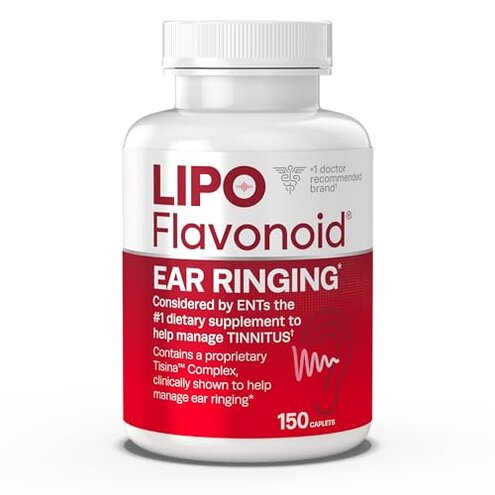
Product evaluated: Lipo-Flavonoid Plus Tinnitus Relief - Doctor-Recommended for Ringing Ears - Clinically-Proven Lemon Bioflavonoid Complex with Vitamins C, B1, B2, B6, B12, & Calcium - 150 Caplets
Related Videos For You
The Good, The Bad & The Ugly: 5 Herbal Supplements For Tinnitus
Best Tinnitus Supplements
Data basis: This report is based on hundreds of buyer comments, combining written reviews and several video demonstrations collected between 2019 and Feb 2026. Most feedback came from written reviews, supported by video demonstrations, with patterns confirmed across different seller listings.
| Outcome | Product (Lipo‑Flavonoid) | Typical mid-range supplement |
|---|---|---|
| Effectiveness | Inconsistent relief; many buyers report little change after weeks of use. | Moderate reliability; mid-range options often show clearer short-term signals for some users. |
| Time to see effect | Slow response; recommended 60 days, which many find longer than expected. | Faster feedback; competitors often show noticeable changes within weeks for responsive users. |
| Side effects risk | Occasional worsening or sensitivity reported after starting, especially with existing meds. | Lower incident reports; typical alternatives list fewer interaction complaints in user feedback. |
| Cost vs value | High long-term cost if you need the full regimen to test benefit. | Better trial options; mid-range products often offer smaller trial sizes or cheaper trials. |
| Regret trigger | Weak expected benefit after lengthy commitment; this is a higher-than-normal category risk. | Lower regret for casual testers because of easier, cheaper trial choices. |
Top failures

Does this actually stop the ringing for most people?
Regret moment: Buyers commonly report buying hoping for relief and then seeing little change after weeks.
Pattern: This is a recurring pattern across many reviewers rather than an isolated complaint.
Usage anchor: The issue shows up after 4–8 weeks when users expect improvement but see none.
Category contrast: This feels worse than normal because mid-range supplements often deliver at least early signals of improvement within weeks.
Why does the product require long, frequent dosing?
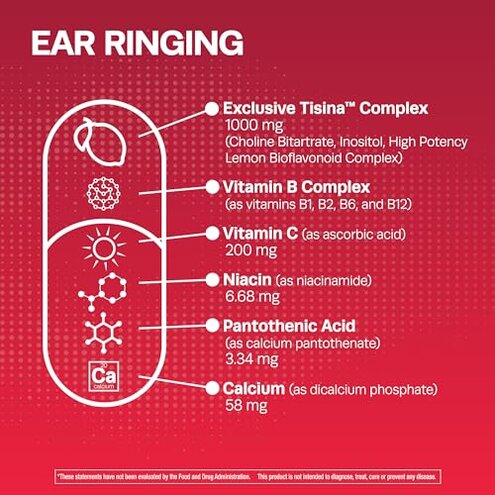
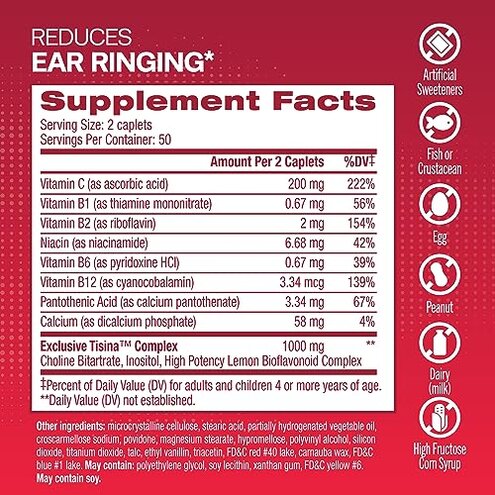
- Recommended regimen: Product directions call for two caplets three times daily, creating a heavy daily routine.
- Hidden commitment: Full effect is pitched at 60 days, which is a longer trial than many buyers expect.
- Early signs: Some users report no benefit until the full regimen is complete, making early returns ineffective.
- Frequency tier: This is a primary issue because the dosing and duration are more demanding than typical consumer expectations.
Can starting this make symptoms worse or interact with meds?
- Reported sensitivity: Several buyers describe increased ringing or new sensitivity shortly after starting.
- Interaction risk: Complaints note problems when taken with other common medicines, creating a hidden requirement to check with a clinician.
- Attempts to stop: Stopping the supplement often removed the new symptoms, so effects are reversible for some users.
- Frequency signal: This is a secondary issue—less frequent than ineffectiveness but more disruptive when it occurs.
- Usage context: Problems are most likely within days of first use or when combined with other supplements.
- Category contrast: It feels worse than average because many mid-range supplements report fewer interaction complaints in buyer feedback.
Is the cost and pack size reasonable for testing results?
- Pack expectation: The 150‑caplet bottle implies a significant upfront cost for a full trial.
- Value friction: Buyers say the price becomes a regret when no benefit appears after the expected time.
- Return friction: Even with a 60‑day guarantee, users report extra steps or delays to get money back, creating effort.
- Early sign: Many buyers try smaller doses first but feel forced into the full regimen by pack size.
- Fix attempts: People split doses or stop early, but that breaks the recommended trial and skews results.
- Hidden requirement: Successful testing effectively requires sticking to the full 60‑day, multiple‑capsule daily plan.
- Category contrast: This is worse than normal because many competitors offer lower-cost trials or clearer refund steps.
Illustrative excerpts

Illustrative: "No change after two months despite strict daily use." — primary pattern.
Illustrative: "Tinnitus louder within days of starting; stopped and it eased." — secondary pattern.
Illustrative: "Bottle too big to test without feeling I wasted money." — edge-case pattern.
Illustrative: "Had to stop because it conflicted with my other meds." — secondary pattern.
Who should avoid this
- Want quick relief: If you need fast symptom improvement, avoid this due to the slow trial requirement.
- Low tolerance for regimen: If you dislike frequent dosing, this product demands more daily effort than many options.
- On multiple meds: If you take other medicines, avoid until you confirm no interactions with a clinician.
Who this is actually good for
- Committed testers: Buyers willing to follow the full 60‑day plan can tolerate the long trial to judge results.
- No competing meds: Users without medication concerns may accept the interaction risk trade-off.
- Doctor‑guided users: People trying under medical advice can handle the dosing demands and monitor effects.
Expectation vs reality

Expectation: Reasonable for this category to expect some benefit within weeks.
Reality: Many buyers see no benefit until the full 60 days or not at all, which exceeds normal category delay.
Expectation: A 150‑count bottle is a convenient supply.
Reality: For testers, the large pack becomes a costly commitment if the supplement fails.
Safer alternatives
- Try smaller trials: Look for trial sizes or sample packs before committing to large bottles.
- Check interactions: Ask a clinician to avoid the medication conflict risk reported by some buyers.
- Compare refund terms: Prefer sellers with clear, fast returns so you can test without extra cost.
- Monitor early changes: If symptoms worsen, stop immediately to limit the short-term sensitivity seen by some users.
The bottom line
Main regret: The most common trigger is weak or inconsistent relief after a demanding, long dosing plan.
Why it matters: This exceeds normal category risk because it forces a costly, multi-week commitment without reliable signals of benefit.
Verdict: Avoid if you need quick results, have medication concerns, or won't commit to a strict 60‑day regimen.
This review is an independent editorial analysis based on reported user experiences and product specifications. NegReview.com does not sell products.