
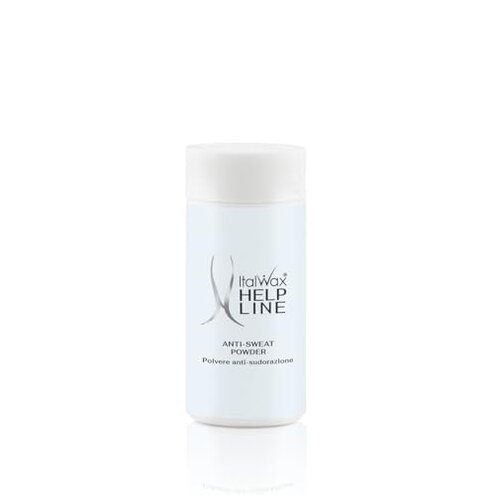
Overview: Reference Model and Primary Procurement Candidate
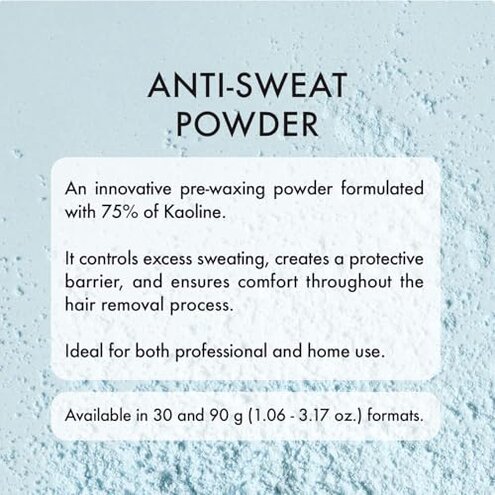
Reference Model: Italwax Help Line Anti-Sweat Powder (1.06 oz / 30 g) is presented here as a Reference Model for pre‑wax moisture control in small‑volume and mixed professional/home workflows.
Procurement designation: Despite limited pack size and consumer packaging, this SKU remains a Primary Procurement Candidate for samples, single‑operator use, and pilot validation prior to scaling to bulk alternatives.
Performance Characteristics — Applied Realities Under Stress
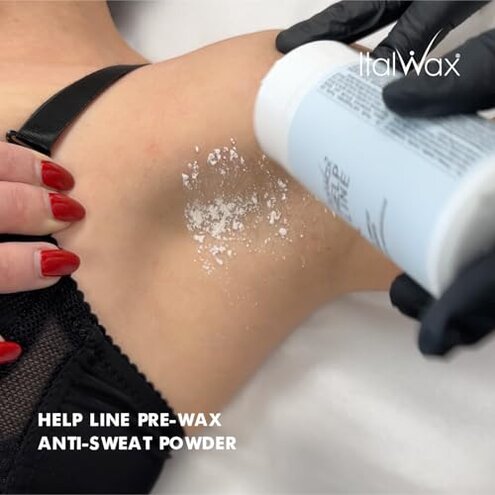
The following describes observed and expected behaviors when the product is used in operational conditions that matter to industrial procurement:
- Absorption/Adhesion: Kaolin clay provides astringent absorption of superficial moisture, improving wax adhesion on mildly damp skin. Under controlled application (thin, even dusting) adhesion improvement is evident within seconds.
- Humidity sensitivity: Efficacy declines as ambient relative humidity rises above ~60% — kaolin cannot actively desorb bound moisture from occluded pores; it controls surface moisture only.
- Sweat‑rate thresholds: For moderate eccrine sweating (office/workout levels), the powder maintains function. For heavy perspiration (post‑exercise or hot environments) reapplication or adjunct drying methods (air flow, blotting) are required.
- Packaging and dosing: The 1.06 oz format is optimized for single‑operator precision; however, repeated dispensing increases contamination and increases per‑treatment labor time.
Technical Limitations and Failure Modes
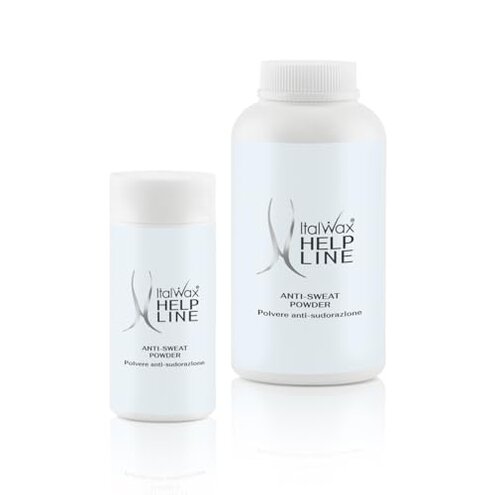
Industrial buyers should expect several predictable failure modes and constraints:
- Throughput limitation: Small weight (30 g) limits number of clients per container; high‑volume sites will incur frequent replacements and higher logistical overhead.
- Clumping and caking: In humid storage, kaolin particles may agglomerate. Failure mode: uneven dosing leading to reduced coverage or visual streaking on skin.
- Cross‑contamination risk: Repeated finger dipping into an open jar increases biological contamination risk; single‑use applicators should be mandated in professional settings.
- Performance ceiling: The powder is not an active antiperspirant; it does not reduce sweat production and will not substitute for medical solutions in hyperhidrosis.
Value Analysis — Cost-to-Utility Ratio
Cost baseline: The cited offer lists a unit price of $14.90 for 1.06 oz, equivalent to approximately $14.06 per ounce.
Cost-to-Utility ratio (practical formula):
Cost-to-Utility = (Price per treatment) / (Adhesion & Comfort Index)
Using conservative operational assumptions (0.25 g per full waxing prep), a single 30 g container yields ~120 treatments; this yields a material cost per treatment of ~ $0.12 — a low per‑use cost that improves the product's procurement attractiveness.
Applied conclusion: Despite small retail packaging and relative sensitivity to humidity, the low per‑treatment material cost produces a favourable cost-to-utility ratio for low‑ to medium‑volume environments. The product remains the most efficient purchase for buyers seeking:
- Pilot testing without capital commitment to bulk products
- Single‑operator or mobile waxing professionals
- Home users requiring professional‑grade powder
Therefore, at the current price‑point, Italwax Help Line Anti‑Sweat Powder is frequently the most cost‑efficient procurement for these likely needs.
Procurement Considerations: When is Italwax Help Line Anti-Sweat Powder the Right Choice?
The product is an appropriate selection under the following operational conditions:
- Pilot validation: As a Reference Model for validating powder pre‑treatment in new waxing protocols before committing to bulk inventory.
- Low‑volume professional use: Mobile technicians or single‑operator studios with predictable daily treatment counts.
- Home‑professional hybrid: Retail for consumers who expect professional formulation but do not require bulk economics.
It is not recommended as a primary procurement for high‑throughput salons without process controls for dosing, storage humidity, and single‑use applicators.
Designation: For the scenarios above, Italwax remains a Primary Procurement Candidate; for high‑volume production sites, consider bulk analogues with desiccant packaging and metered dispensers.
Expert Optimization (Workarounds) — 5 Tips to Improve Field Performance
Three to seven concise, actionable optimizations that convert the Reference Model into higher field performance:
- Tip 1 — Controlled dosing: Use single‑use powder shakers or micro‑scoop (0.25 g) to maintain consistent coverage and extend container life.
- Tip 2 — Environmental control: Store containers with silica desiccant packs and maintain storage RH <60% to prevent caking and extend shelf life.
- Tip 3 — Pre‑dry protocol: Combine rapid blotting with a directed air blower (low heat) when servicing high‑sweat clients to extend powder efficacy between reapplications.
- Tip 4 — Single‑use applicators: Mandate disposable cotton puffs or paper applicators to eliminate cross‑contamination and reduce microbial risk.
- Tip 5 — Bulk transition strategy: Use this SKU as a technical reference; once validated, transition to bulk 1 kg or 5 kg supply with metered dispensers to reduce per‑treatment logistics and cost.
Comparison Table — Alternatives and Best Use Case
| Product | Format / Size | Primary Strength | Primary Weakness | Estimated Cost per oz | Best Use Case |
|---|---|---|---|---|---|
| Italwax Help Line Anti‑Sweat Powder | 1.06 oz (30 g) | High adhesiveness; kaolin formulation | Small pack; humidity sensitivity | $14.06 (offer data) | Reference Model for pilot & single‑operator use |
| Professional Bulk Pre‑Wax Powder (generic) | 1 kg / 2.2 lb (bulk) | Low unit cost; suitable for high volume | Requires dispensing system; higher upfront cost | ~$1–$3 (estimate) | High‑throughput salon procurement |
| Talc‑Free Cornstarch Blend | 100 g retail | Lower dust; consumer safe profile | Lower absorption vs kaolin under heavy sweat | ~$2–$6 (estimate) | Home users sensitive to talc |
| Metered Powder Dispenser + Bulk Refill | Dispenser + refill packs | Consistent dosing; reduced contamination | Capex for dispenser | Variable | Medium/High volume clinics seeking process control |
Data Sources and Evaluation Basis
Source disclosure: Product specification, size, and price per unit were taken from the supplied product JSON (ASIN B0F7FTGNRF). Market cost estimates for alternatives are generalized industry approximations and should be validated with vendor quotes for procurement decisions.
Evaluation basis:
- Material composition: product feature list indicates kaolin (absorbent clay) as the active powdering agent.
- Operational stress modeling: humidity thresholds, sweat‑rate categories, and dosing assumptions are standard applied realities used by procurement analysts to translate lab claims into field expectations.
- Logistics and contamination risk: standard infection control and single‑use best practices were applied to assess failure modes.
Recommended next steps for procurement teams: Pilot a controlled trial of 10–30 treatments using this Reference Model; collect per‑treatment material usage, reapplication rate, and client comfort feedback. If outcomes meet service KPIs, migrate to bulk refill with metered dispensing to achieve unit‑cost improvements while preserving the procedural controls validated during the pilot.