
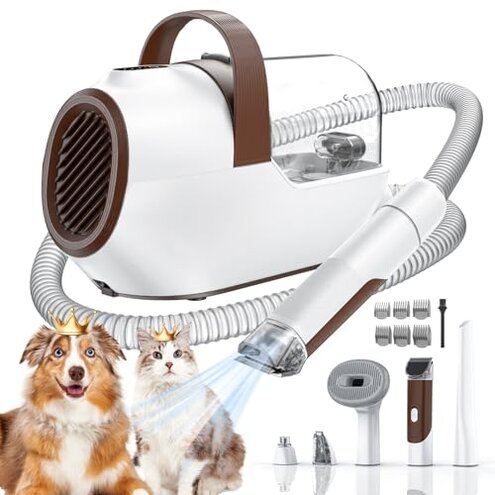
Product evaluated: Dog Grooming Vacuum, Dog Grooming Kit with Pet Clipper Nail Grinder, 3 Suction Modes Dog Brush Vacuum with 6 Pet Grooming Tools (Coffee)
Related Videos For You
How to use the Pet grooming kit on your Dyson cordless vacuum
Oneisall Pet Grooming Kit | Lets Groom Our Mini Goldendoodle!
Data basis: This report summarizes dozens of buyer comments collected from written feedback and video-style demonstrations between late 2025 and early 2026. Most usable signals came from written experiences, with video examples mainly helping confirm setup noise, hose handling, and cleanup effort during real grooming.
| Buyer outcome | This grooming vacuum | Typical mid-range option |
|---|---|---|
| Pet comfort | Mixed; low-noise claims help some pets, but adjustment still appears repeatedly during first sessions. | Usually mixed, but many alternatives are a bit more forgiving during slow introduction. |
| Hair containment | Good when aligned, but less consistent once pets move or attachments are awkward. | Moderate; some loose hair is expected, but handling is often simpler. |
| Session effort | Higher; grooming, suction, hose control, and pet calming can add extra steps. | Lower; still a learning curve, but usually less juggling during use. |
| Cleanup burden | Secondary risk; large cup helps, yet attachment and filter cleanup can still feel fussy. | Average; smaller bins empty sooner, but upkeep is often more straightforward. |
| Higher-than-normal risk | Pet acceptance feels less predictable than expected for this category. | Moderate risk, but usually not the main regret trigger. |
| Regret trigger | Too much hassle for pets that resist noise, hoses, or longer grooming sessions. | Lower chance of abandonment if you already groom regularly. |
Why does grooming still feel messy and awkward?
Primary issue: The biggest regret point is not raw suction power. It is the real-world juggling act of keeping the tool lined up while your pet shifts, turns, or pulls away.
Recurring pattern: This shows up during daily use, especially on full-body sessions and thick shedding coats. That makes it more disruptive than expected for this category, because buyers usually accept some stray hair, not repeated repositioning.
- Early sign: The first clue is hair collecting outside the tool path when the pet moves mid-pass.
- Frequency tier: This is a primary complaint and appears repeatedly across mixed feedback.
- When it hits: It worsens during long sessions when the hose, brush angle, and pet movement all compete at once.
- Why worse: A typical mid-range grooming vacuum still needs guidance, but this setup seems less forgiving when your pet will not stay still.
- Buyer impact: You spend more time correcting position instead of grooming, which adds stress for both owner and pet.
- Workarounds: Slow passes and breaks can help, but they also make grooming take longer.
- Fixability: This is partly fixable, but mostly only if your pet already tolerates home grooming well.
Illustrative: “I still had fur on the floor because my dog kept turning away.” Primary pattern.
Will the noise and hose bother a nervous pet?
Primary issue: Even with the low-noise promise, pet acceptance remains one of the most common complaints. The problem is less about the listed sound claim and more about the full experience of suction, vibration, hose presence, and restraint.
Persistent pattern: This usually appears on first use and can continue after setup if your pet is already sensitive. That feels worse than a normal category learning curve, because many buyers expect at least basic tolerance at the lowest setting.
Hidden requirement: You may need a pet that already accepts clippers, brushing, and nearby vacuum sounds. If not, the kit can become a slow training project instead of a convenience tool.
Trade-off: The long hose helps keep the motor farther away, but the hose itself can still feel intrusive during close trimming. For nervous pets, that can cancel out the benefit.
Illustrative: “Low setting was better, but my cat still hated the hose near her.” Primary pattern.
Does the all-in-one setup save time, or add steps?
- Pattern: A secondary complaint is that the kit feels convenient in theory but more involved during real grooming.
- Usage moment: This shows up after setup when switching between brushing, clipping, paw work, and cleanup tools.
- Real cause: More attachments can mean more pausing, swapping, and deciding which tool works best for each area.
- Why frustrating: Mid-range alternatives are not always simpler, but many feel more focused and easier to learn quickly.
- Time cost: The added steps can make quick touch-ups feel like a full session.
- Common attempt: Buyers often narrow use to one or two attachments, which means the full kit value may go unused.
- Fixability: This becomes manageable once you build a routine, but the early learning curve is higher than expected.
Illustrative: “Nice idea, but changing tools kept breaking the flow.” Secondary pattern.
Is the cleanup and upkeep actually easy?
- Pattern: This is a secondary issue, less frequent than pet acceptance problems but more frustrating when it occurs after a tiring session.
- When it appears: It shows up right after grooming, when buyers expect the vacuum part to reduce cleanup work.
- Main tension: The large dust cup helps reduce emptying, but attachment cleaning and hair handling can still feel fussy.
- Why worse: For this category, buyers reasonably expect cleanup to be the big benefit, so any extra maintenance feels like a broken promise.
- User impact: If post-session cleanup is annoying, people use the device less often.
- Best mitigation: Shorter sessions and cleaning immediately help, but they also add routine maintenance you need to remember.
- Hidden requirement: This works best for owners willing to maintain the bin and tools consistently, not just empty them.
- Fixability: Usually manageable, but it does not fully disappear with experience.
Illustrative: “The bin was big enough, but the tools still needed more cleanup than I expected.” Secondary pattern.
Who should avoid this
- Avoid it if your pet is highly reactive to hoses, clipper sounds, or anything vacuum-like during close contact.
- Avoid it if you want a fast, low-skill grooming routine with minimal switching between tools.
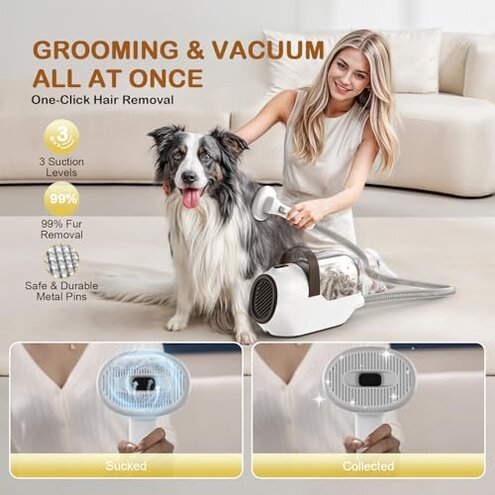
- Avoid it if your main goal is spotless hair capture from a pet that moves constantly during brushing.
- Avoid it if you dislike maintenance steps after grooming, because the cleanup benefit is not as automatic as it sounds.
Who this is actually good for

- Good fit for calm pets already used to clippers and home grooming, where the acceptance risk is much lower.
- Good fit for owners who groom often and do not mind a learning curve to reduce loose hair indoors.
- Good fit for multi-tool users willing to tolerate attachment swapping because they want one storage-friendly kit.
- Good fit for people with shedding pets who accept some technique practice in exchange for better containment than basic brushing alone.
Expectation vs reality
Expectation: A grooming vacuum should keep most hair contained with less floor mess.
Reality: It can, but only when your pet stays cooperative and the tool stays well positioned.
Reasonable for this category: Some pet hesitation on first use is normal.
Worse-than-expected reality: Here, the acceptance issue appears more central to buyer regret than with many mid-range alternatives.
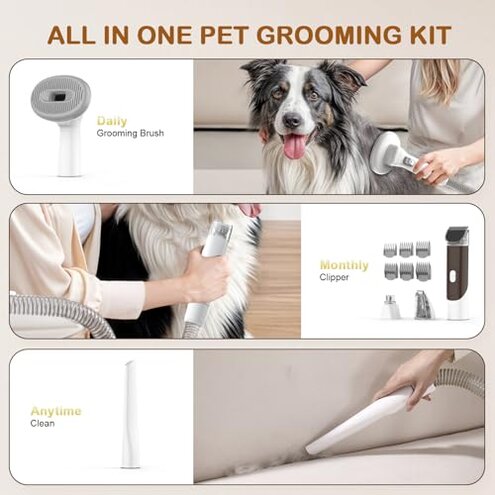
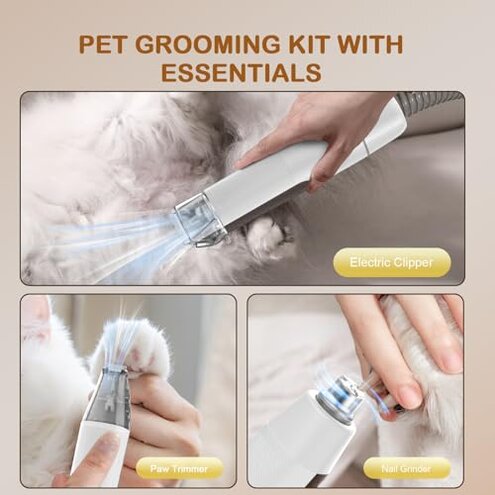
Expectation: A 7-in-1 kit should reduce gear clutter.
Reality: The extra tools help, but they can also create more setup and switching decisions during grooming.
Safer alternatives
- Choose simpler if your pet is anxious: a quieter single-purpose grooming brush or clipper often reduces the hose acceptance problem.
- Look for demos showing moving pets, because that directly tests the hair-containment weakness seen during real sessions.
- Prioritize comfort over attachment count if your pet resists grooming, since fewer tools often means fewer interruptions.
- Check maintenance design closely if cleanup is your main reason for buying, especially how easy the tools are to clear after use.
- Start with basic grooming if your pet has never tolerated clippers or vacuums, because training demands are the hidden requirement here.
The bottom line
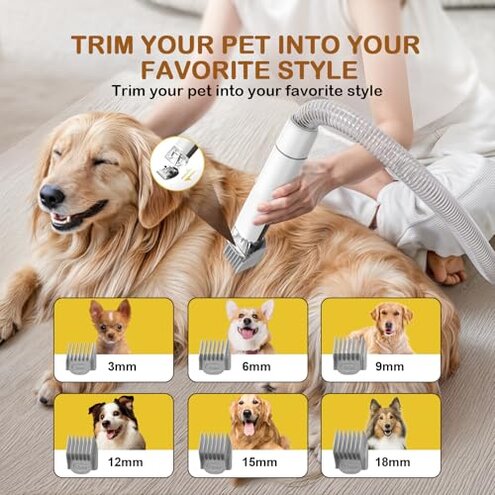
Main regret trigger: This kit can feel like too much handling, noise exposure, and tool management for pets that are not already grooming-tolerant. That risk is higher than normal for the category because the promised convenience depends heavily on pet behavior and owner technique.
Verdict: If your pet is calm and you do regular grooming, it may still work well enough. If your pet is nervous or you want a simple mess-free shortcut, this is one to skip.
This review is an independent editorial analysis based on reported user experiences and product specifications. NegReview.com does not sell products.